Tuesday, November 28, 2006

The Young Ones

Gearing up for the final push.....

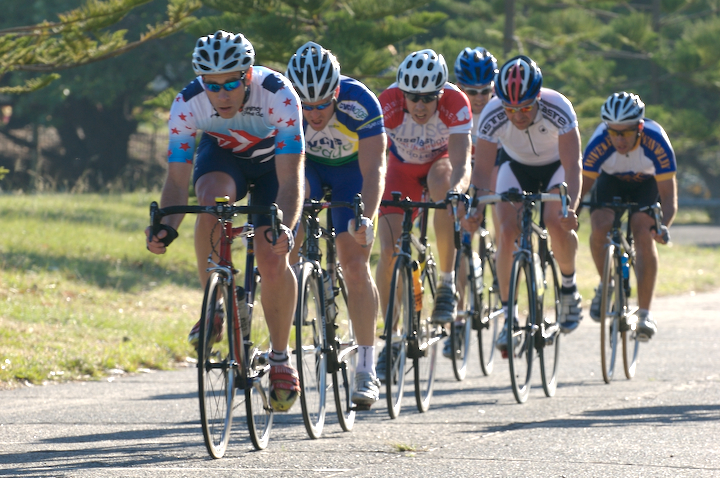
Track racing is popular with the kids

Paul Craft's unique and well lubricated commentary kept us amused all afternoon and well into Saturday evening during the Central Coast Track Open at the outdoor 460 metre Adcock Park track located at West Gosford. Hosting 55 track cycling events covering a Junior and Senior racing carnival is no mean feat for any sporting club club, so thanks to all the organisers and helpers for making the day's racing fun. The carnival started in windy conditions which eased as the evening settled.

The junior events attract good fields

The junior carnival is pretty popular and for a local town track carnival, this is pretty typical of what you'll see in towns across the country. Grass roots racing certainly keeps the sport healthy.
For myself, it was my first open racing in the new club colours. Given the top B-grade handicap mark (110 metres), I had six races for the evening:
  1. 5km Scratch race (3rd)
  2. Keirin Heat (2nd)
  3. 1.8km Wheelrace heat (missed qualifying for final);
  4. A/B/C grade Handicap Miss'n'Out (3rd);
  5. Keirin Final (4th)
  6. 12km A/B Combined Scratch Race (no placing, retired gracefully with 1/2 lap to go along with former junior world and Australian elite champion Shaun Hopkins)
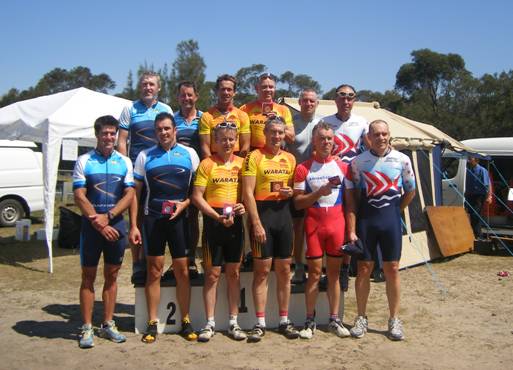
The new suit

Scratch races and Keirins are pretty well known but two races that may not be as well understood are the Wheelrace and Handicap Miss'n'Out. Click the link to get a little more info if interested. The Miss'n'Out is explained at the bottom of this post.


Some race day stats:

CTL:___________ 89.1
TSB:_________ + 25
TSS:__________ 137.6
Max Speed:_____ 60 km/h
Max Power:___ 1391 watts
Gear:_______ 48x14 (92.6")

Clearly I was plenty rested for the event with a large positive TSB. Coach had backed off training a little after a few signs were emerging that I needed a bit of a breather.

I was pleased at being competitive in the Keirin as it's a sprint event and not my target type of race (my focus is on enduro racing). My best result was the 3rd place in the Miss'n'Out, eventually outlasting all 40 riders bar Peter Fitzpatrick (2006 Australian Elite Madison Championship bronze medallist) and top U-23 enduro rider Phil Stokes. Indeed these guys are in final prep for the State elite track championship in a couple of weeks and their form ain't exactly shabby.

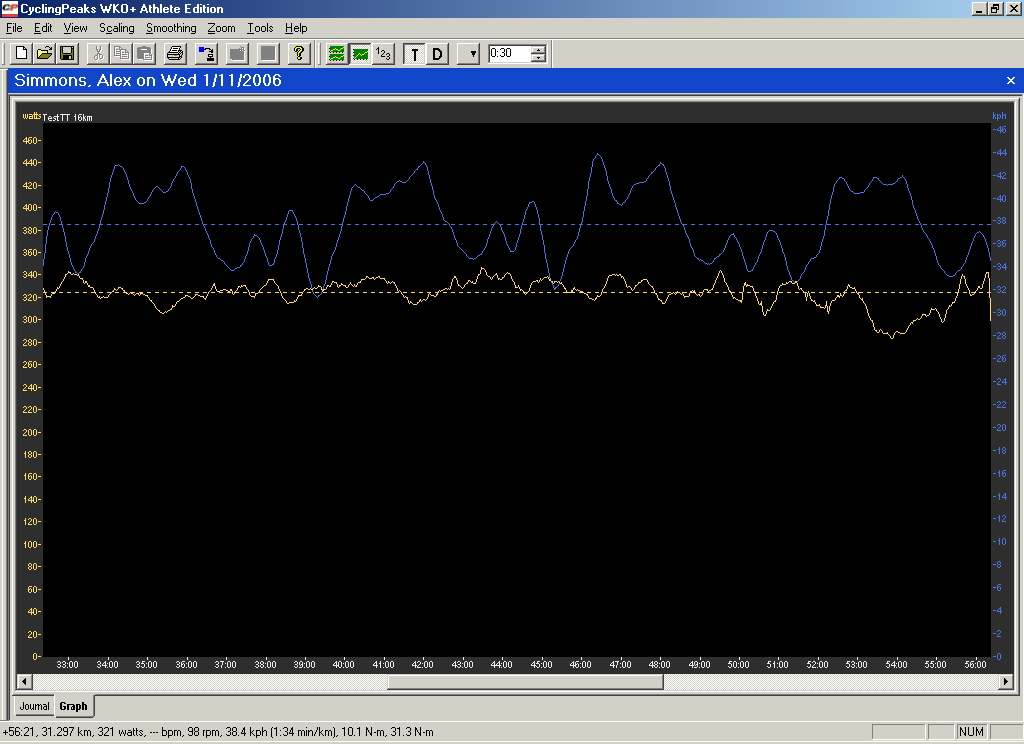
The final scratch race was pretty hard with the top enduro boys cranking it up several times in an effort to drop the sprinters. Here's a screen shot of the closing scratch race power file for interest. Click on the image to see a larger, clearer version
(right click to view in a new window) .
The two dotted horizontal lines mark the average speed (blue) and power (yellow). Stats are shown on the left. Ignore the cadence numbers, they are wrong (I don't use the cadence sensor on the track bike and should turn off the hub cadence function).

Note the repeated increases in speed and the power required to respond to the accelerations. This is pretty typical of enduro riders trying to rid the bunch of the sprinters by picking up the pace and then the spirnters and/or less fit attempting to slow it down again. It can be pretty ruthless. You know the tactic is working when world champion riders get spat out eventually.

Anyway - a pretty good night's racing and my form was, according to a fellow competitor
(a World's Masters track champion himself) who wasn't racing as his two boys were busy cleaning up in the junior carnival, "better than I've ever seen". Nice compliment.

"Form = Fitness plus Freshness" ~ A. Coggan.
"Form = Compliments from Competitors" ~ A. Simmons.
Next stop: a local crit then a trip to Canberra to visit Mum and race the Brindabella Challenge Crit.

Miss'N'Out (courtesy of FNWTR):

The bike equivalent of musical chairs, sometimes called the Elimination or "Devil's Race", every lap the last rider across the finish line is pulled out of the race until only two riders remain. These two are given the bell for the final sprint lap. Keep your eyes on the back of the field, that's where all the excitement lies in this event.
In a handicap format, riders are split into grades starting at different points on the track, meaning the top riders lose one per lap from their bunch until they catch the bunch(es) in front.
Photos courtesy of David Lane at Action Snaps

Read More......

Friday, November 24, 2006

Planning a Comeback with the Performance Manager

Tanya making her return to racing on 18 November
US Independence Day 2006 was the same day my good friend and former coach, Tanya, went under the surgeon's knife at Sydney's Prince of Wales Hospital. Diagnosed with bowel cancer a couple of weeks earlier, it was quite a rude shock to realise there was a substantial tumour needing removal. Especially as Tanya was in final build phases in preparation for a trip to the UK to compete at the World Masters Track Cycling Championships. Indeed it was her inconsistent responses to training that led Tanya to investigate possible health problems. Just as well.

The surgery was successful and Tanya was fortunate that there were no complications. Chemotherapy was an option but deemed unlikely to provide an improved long term prognosis, so Tanya decided against it, preferring to get back to her normal life as soon as practicable. Her recovery was pretty quick but "activity" in the sense that competitive riders know it, was still some way off.

First off it was to get home from the hospital, then gradually to move about, short walks, longer walks and so on, until the first chance to put the bike on the trainer and gently turn the cranks.


Exactly eight weeks after going into surgery, Tanya had her first ride outdoors.
Tanya runs a full time cycle coaching business (Onyabike Cycle Coaching) and has for many years understood the importance of power measurement as the objective means of determining fitness and tracking improvement. Tanya has her own Computrainer but did not have on-bike power measurement. That was all about to change and Tanya finally took the plunge and ordered Powertap wheels for her road and track bikes.

Then she asked me to guide her training back into the sport. Quite an irony really, pupil becoming the coach's coach! I knew this would be a challenge but how on earth do you plan, track and monitor
training loads for someone who's been through all that? Not a light responsibility by any stretch. Especially a coach so eager to learn!

Enter the Performance Manager and the Charts it provides (PMC). Combined with the lessons from applying the PMC to myself and being most fortunate to be a member of the eweTSS (PMC) beta test group (the PMC brains trust), I knew that this was the perfect tool to help manage Tanya back to fitness.

We both decided that a medium term goal was the best thing and so Tanya chose to aim for getting in good enough shape to ride the shorter option at the Alpine Classic Audax event on 27 January 2007. After that, well, let's get there first and we'll see....(but a comeback to racing was always the intention).

So, we started gently, with the
first couple of weeks about reacquainting herself with riding and getting back that "it's normal to be on the bike" feeling. It was also a time of learning how to use the Powertap and Cycling Peaks (and solving a troublesome download problem - which turned out to be a loose connection in one of her laptop's USB ports).
It was far too early to be asking her to undergo the stress of MAP (maximal aerobic power) or FTP (functional threshold power) testing, so I estimated her MAP & FTP and set training levels based on a previous ramp test, of which we had plenty to choose from - so I picked one from when she was just starting out and the least fit. Being precise wouldn't matter too much in the first few weeks, and we would schedule formal power tests eventually.

Tanya being Tanya though, had to do a bit extra on a couple of days (simply so keen to get back into it) and we saw relatively high TSS on those days. The impacts were felt in the days after and so eventually we agreed the merits of a conservative build.

A month after starting back on the bike, Tanya went on a family break with her husband Eddie and took the mountain bike for something different. So I gave her some guidelines on what type of rides to do and how we were going to estimate TSS on those days she wasn't using the power meter.

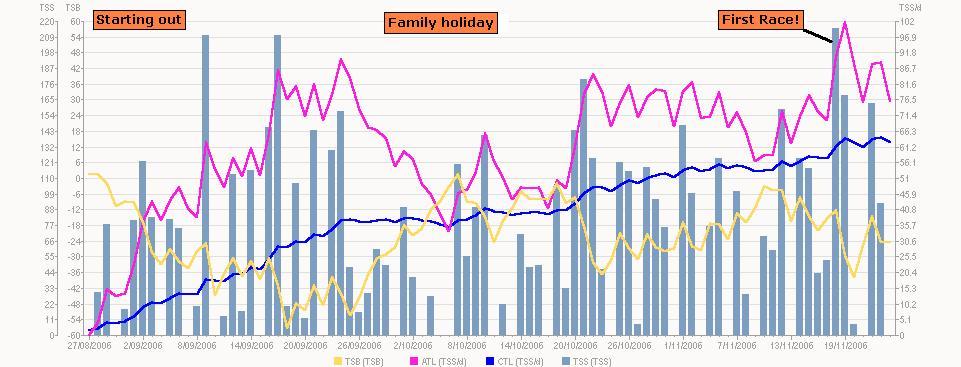
Here is a picture of her PMC to date (click on it to see a larger view - or right click to open in a new window):

Tanya's PMC since 27 August 2006

Since returning from her holiday, it's been a matter of gradually building the duration and/or intensity of her rides and fitting these around her busy schedule of delivering cycle coaching and courses. We were also able to conduct formal testing with the power meter and reset her training levels accordingly. In her case we did both a MAP test and two short TTs to help set benchmarks and FTP via the Monod Critical Power model. I give her estimates of TSS I expected to see from each ride/workout and as the "ride library" grows, we are both able to better manage the overall stress and day to day effort.
So we see from the PMC that Tanya has managed a steady ramp up from a zero base over 12 weeks to a CTL in the low 60's (a ramp rate of just over 5 points / week). For some that would be a tough rate but given we were starting from zero and her fitness (FTP) would likely improve through this phase, we found that ramp rate has been sustainable so far.

Tanya also takes her Performance Manager Chart to regular checks with her doctors and specialists, so she can prove she's not "overdoing it"!
Happy to report that just 12 weeks after getting on the bike for the first time since her surgery, Tanya competed in the same club crit as I reported on here - and did rather well hanging in there for many laps. Here are her stats:

Club crit:
Duration:___ 37:40
TSS:________ 84.3 (intensity factor 1.159)
VI:__________ 1.08
CTL_________ 61.4
TSB:_______ -12.3

I think from those numbers (especially the Intensity Factor) we may need to retest as it would seem Tanya's fitness has taken another leap forward.
Tanya can see her fitness has improved significantly since starting back and is beginning to entertain thoughts of competing at the State and National Masters Track Championships in March 2007, something we didn't really rule in or out three months ago. So, after discussing that, we will begin to introduce more track specific training into her weekly routine, since that is what she loves doing the most.

In summary, the Performance Manager is giving both Tanya (the athlete) and myself (the coach) a quantifiable means by which to plan, track and manage training loads appropriate for her comeback to competitive cycling.
It gives both of us confidence we are building her return to fitness in a sustainable manner.

I will report again on progress in a few months.

Read More......

Tuesday, November 21, 2006

Trials and tribulations

Well, more trial than tribulation.....

Here I am in pursuit mode
(this one's from the team pursuit titles earlier this year)
Last night I was scheduled to ride a trial individual pursuit - to set an early benchmark as I progress towards State & National Masters track champs in March. For me this means a 3,000 metre effort from a standing start on a velodrome. Fortunately I have good access to a world class indoor facility - the Dunc Gray Velodrome. And given that, along with John "JB" Beatty, I supervise the Monday night track training at DGV, I pulled coach's privilege and had a ride myself.
The individual pursuit is a funny event - it plays with your mind. But that's a whole other story.
So after a warm up I get the track to myself and decide on a schedule to ride a 3min 50 sec time.

Here's the result:

The power and speed graph from my trial pursuit last night.

And the numbers:
Pursuit Trial:
Duration: 3:14
Distance: 2.496 km_________Min_____Max_____Avg
Power:___346_____892_____433 watts
Speed:___8.3____48.5____46.2 kph
Temp:_____________________24 C
Air P:__________________1016 hPa
Cruise speed:_____________47 kph
Gear:___________49x14 (94.5")
Cadence at cruise________107 rpm
CTL:____________________93.4
TSB:___________________ +1.5


The more astute reader will notice I pulled the pin with 2 laps to go. Maybe that was the wrong thing to do but it was the decision I made on the spot - I just wasn't ready to dig a big hole for myself. I was going slower by that stage and speed wasn't great to start with.

An all time 3 min power PB though. By quite some margin so the training on the engine is working fine.
Hmmm. Don't really understand the slow speed for such power?

I started out pretty conservatively for me, peak power under 900 Watts and I didn't overshoot the target speed by much (if at all). So all I can conclude is that I need to work more on the aero position. I have a new frame in mind which will provide a far greater opportunity to improve my aerodynamics. On my current rig I am using a Look Ergo stem and it is just about already at full downward tilt. I'll just keep playing with it.

'til next time....

Next weekend is the Central Coast track open. Should be a hoot.

Read More......

Saturday, November 18, 2006

Farewell Crit

Today was a fun race.

Driving the small scratch bunch down the straight at Heffron

It was my last with the Sydney Cycling Club as I am moving to a new club, Bicisport. The reasons for my move are positive ones and there is no animosity at all with SCC. I simply want to follow my passion of hard but enjoyable track racing as I build towards the State, National and World Masters Championships in 2007 and so I need to train and race with like minded guys.

So I have joined Bicisport along with my regular track training buddies. SCC doesn't have much of a track racing culture (believe me I've tried to change that over the years but to no avail), so I have decided to stop swimming against the tide and get with the strength. My first race in the new colours will be next weekend's Central Coast Track Open. Hearing Paul Craft's commentating should liven up the evening no matter the results.


Anyway, back to today's race. Another Handicap Crit format - 10 laps, 20km. Six minutes to limit. I have already described these race formats in a previous post, so if you don't know what I mean - click the link and have a read.

I was also the handicapper! Just to add some spice into the race, joining us for the first time was current Australian Masters Crit champ (and former World Masters crit champ) Liam Kelly, and Discovery Channel's recent signing, Aussie Matt White.
Matt & Liam doing it tough. Sorry 'bout the handicap boys!

Being a kind fellow, I made them start 30 seconds behind the normal scratch boys (myself included). Sorry lads (as it turned out) since they never caught us. Nice to ride away from a seasoned pro like that. My small group of five was made up of the usual suspects (Stan, Doddsie, Simon, Chris and myself) and worked together pretty well with only one passenger. We averaged 41.7 km/h (25.9 mph) for a little under 30 min on the semi-technical Heffron Circuit and I did some pretty solid turns today. The result didn't matter to me since I was more interested in getting a good workout.
Sshhhh - coach had me down for a 20 min time trial effort today but I figured a 30 min race would be just as good if I did lots of work. I did and it was. I don't think he'll mind ;)
Race Day stats:

Club Crit:
Duration: 29:16
TSS: 58.8 (intensity factor 1.098)
Norm Power: 335
VI: 1.05
Distance: 20.351 km
____________ Min __ Max __ Avg
Power:______ 0 ____ 943 __ 320 watts
Cadence:____ 33 ___ 116 ___ 96 rpm
Speed: _____ 4.6 __ 52.1 _ 41.7 kph

CTL: 95
TSB: +7

So, that's a pretty solid power average for me (indeed had the race lasted a little longer then it would have been a 30 min power PB). When I look back at the previous handicap crit on 28 October, this was over a minute faster! It's amazing what you can do with 5 guys prepared to all work together. Both Average and Normalised power was up on that previous race, so more good signs after the legs felt a bit ordinary this week. I think a little less than optimal amounts of sleep was partly my issue. Good rest is so important when training regularly.
Simon about to lead us into one of Heffron's 9 corners.
Nice tight group riding - there's 5 of us - count the shadows.

We caught what was left of the normal "chopping block" bunch with about 3.5 laps to go so that added 3 more riders to our group but it wasn't enough to overhaul the front bunches, which by this stage had all grouped up and finished about 20 seconds in front of us. Good luck to them - they clearly rode well today.

Club President Barry Doosey won the day in the bunch gallop with good buddy Leigh Ringrose taking 2nd spot. Nice one boys!

Afterwards there were lots of takers at the mobile cafe van dispensing free coffees and in a nice surprise, the club all gathered to give me a farewell thank you and a nice gift to boot. Thanks to Tanya for her kind words and all at the club for their support and camaraderie over the past decade. I'll still be around the park after my training.
Some farewell words from Tanya and a goodbye from the club.
Nice way to go out.

Next up I have a trial pursuit effort on Monday night at DGV and next weekend is the Central Coast Track Open. Can't wait!

Read More......

Monday, November 06, 2006

In Pursuit of Perfect Pacing

(or how to go faster without really trying)

Reproduced from an article I wrote in May 2006 for Velosportz.com.au


The Individual Pursuit is one of cycling’s gold riband events that almost every cyclist should try at least once in their careers. It is one of the most challenging cycling events there is and taxes a cyclist’s abilities to the maximum. It is also a really solid indicator of a rider’s physical abilities across many cycling disciplines. So how on earth do you ride one well?
Well there are a lot of things about being and/or becoming a good pursuit rider and I’m not going to attempt to cover them all here (I certainly don’t profess to be an expert). What I will share is some first hand information about pacing and its importance, since it is the most important skill in pursuiting.

Individual Pursuit (Men/women) – Courtesy of Cyclingnews.com

Held over 4000 metres for elite men and 3000 metres for elite women (shorter for masters riders), this is considered an "endurance" track event, although the speeds are still extremely high. Two riders start on opposite sides of the track and try to set the fastest time over the allotted distance. Normally, a qualifying time trial is ridden that determines who is eligible for the finals. The fastest ride is often produced here, as in the finals, the only important criterion is to beat your opponent. If one rider catches the other, i.e. puts half a lap into them, then the race is over.
An explosive start is not critical (but it's handy to have), however the ability to ride at a consistently high speed is far more important. Many riders who go out too hard can look to be well up on their opponent, only to fade in the last 1000 metres. This has typically the greatest "cross-over" to the road. i.e. good pursuiters make good road riders and vice versa. Brad McGee, Stuart O'Grady, Vjatcheslav Ekimov, and Chris Boardman are a few examples of top pursuiters who have had successful road careers.

Every rider has a limit to his or her anaerobic and aerobic work capacities (and we can all work to improve them). However, come race day, the trick is working out how to best use your current capacities to ride the distance in the shortest time possible. Pacing is the key to success.
Let me demonstrate what I mean.

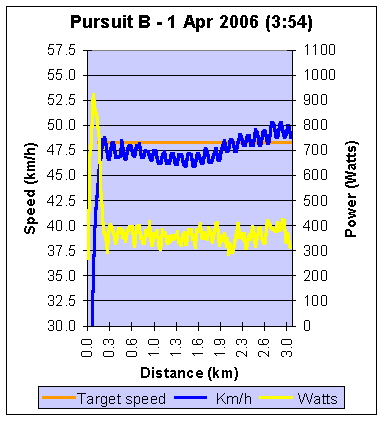
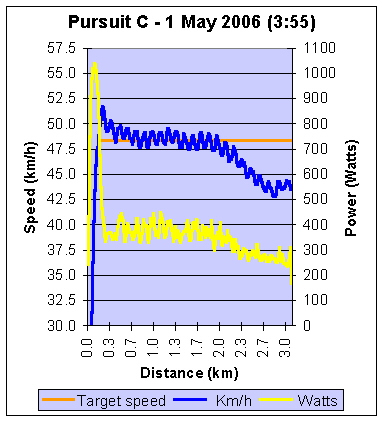
Below are three power and speed charts for Individual Pursuit efforts I have done over the last two months [1]. Apart from the public embarrassment, these charts highlight some really important lessons about pursuit pacing.
Each chart shows three lines:
  • The Blue line is speed - shown against the left axis in km/h
  • The Orange line is target cruise speed (in this case 48.3km/h)
  • The Yellow line is power in watts as shown against the right hand side axis.
The scaling is designed to make the comparisons easy to see and for the differences in pacing to stand out.


[1] Same rider, bike, set up, tyres & venue (an indoor velodrome); Data as recorded by Powertap; Conditions very similar (temperature, barometric pressure).
OK – the first thing you notice is the “sinusoidal" (up ‘n’ down) variance in the blue speed line as recorded by the power meter. This is due to the wheel speed variances caused when going from straights into the curves and back to straights. So you need to follow the overall trend of the blue line.
Secondly, you will notice the large spike in power output at the start, as the power is put down in order to accelerate from a standing start. Note the peak power of a little over 900 Watts before settling down to ride at an average of about 375 Watts.
Ride A is "almost perfect" pacing. Note how the start accelerated to the desired cruising pace, which was maintained through to the end (almost). Perfect pacing would have not seen a drop in pace at all.

Ride B shows a somewhat different pacing strategy.

In this case I started too conservatively, realizing half way that a lift in effort was both needed and possible, resulting in negative splits all the way to the finish (but too late to make use of all the petrol in the tank).
This ride represented a “missed opportunity” as clearly there was more speed available in the legs that day.
Looks like I was the April fool!
Ride C represents the classic pursuit pacing mistake - starting out hard (note peak power this time is well over 1000 watts and initial cruising power/pace is higher than the target) resulting in me being unable to maintain the effort, with the final laps an ugly experience, something I'm sure plenty of others who have ridden the event can relate to.
Now let’s compare the average power outputs with times:

Ride__ Avg Watts__ Time (3km)
__A__ 384 Watts__ 3:49
__B__ 388 Watts__ 3:54
__C__ 377 Watts__ 3:55


It is amazing to see that Ride A has a time 5 seconds faster than ride B but with slightly less average power!
Ride C is typical of many novice pursuiters (myself included). In my case I instructed my caller to use this pacing strategy as I wanted to find out what I really had in me on that day, knowing it was risky and the fact that even a personal best (PB) time was not going to qualify me for finals.
Ride B was my biggest disappointment as I clearly had the legs on the day to do a PB but simply didn't put it all on the line.
Ride A proves that with some practice, especially that crucial first lap and a half, perfect pacing is possible and a PB performance is just around the corner. Just try to hold back in the initial stages (but not too much!).
So how valuable is pacing strategy? Pretty important I would say. Anyone else out there want to knock 5 seconds off his or her pursuit time for no more actual effort?
It is easy to know the theory of perfect pursuit pacing but applying it is another thing altogether, so get to your local track and give it a blast. It’s the most fun on two wheels.
Happy pursuiting!
Alex

Read More......

Wednesday, November 01, 2006

Testing Times

Well today was one of my regularly scheduled fitness tests – the 16km (10 mile) Time Trial effort. I’m not so much interested in the time it takes to complete the course as I am in the average power output for the duration of the effort.

If my fitness has improved (and I’m not too fatigued), then I should put out more power on average than I did last time I tested. It’s a much better gauge of progress than a stopwatch, especially on this day as conditions were quite different.

Regular testing is a really important part of any training programme - firstly it helps determine what your current capabilities are (as measured by average power output over a given duration or distance). That knowledge is then used to shape training plans suitable to improve the capabilities specific to your target event or cycling goal. Finally tests ensure that training is having the desired physiological impact. Adjustments to training can then be made according to results. Besides, tests are great workouts in themselves, so they should be part of any regular training cycle.


Well first let’s get the excuses out of the way…

This week we moved to summertime in Sydney, so the clocks have just gone forward an hour. My mid-week workouts are early morning, so getting up at 5am was really getting up at 4am… I’m not sure the body was quite adapted to surfing the pain curve quite so early in the morning. Then there was this strongish westerly blowing in (an unusual breeze that one) and that was going to make pacing a challenge on the circuit I use. Then in the warm up I’m thinking, why does it sting when I’m not really going that hard?
Oh just shut up and get on with it….

Anyway, with that lot out of the way, we get into the test. But how hard do I go? Well a couple of weeks ago I set a new 20 minute mean maximal power (MMP*) PB in a criterium race at Olympic Park. So I figure, that’s what I’ll aim for. Nothin’ but the best for me!

Ay yay yay! That hurt! In the course of a 4 x 4km laps I rode laps 1 & 2 at around the nominated power, then for some unknown reason I have visions that I can or need to go harder (surely I can go harder?), so I do and lap 3 is cranking (and hurting). Lap 4 was ugly.
Result

Well I beat my last test average power by about 10 Watts and set a new 20 minute MMP PB in the process! So there you go. Not so bad after all. Did I say lap 4 was ugly? Yep, it sure was ugly. I was definitely hurting more today that last time though… or maybe the pain memory of my last test has simply subsided.

Oh, and this is a 46 Watt improvement over my first test in August.
Test day stats:
CTL: 93
TSB: -8 (so reasonably neutral but on RPE it felt more like –15 or so)
And why is it that on power test days you swear the Power Meter reads low?

Here's a pic of the test results (click on pic to enlarge). Note how variable the speed was compared to power. This was partly the slightly up n down nature of the loop I was using but also the wind which was creating a pacing challenge. See the ugly last lap?

Dashed horizontal lines mark average power (yellow) and average speed (blue) for the course.

*MMP – the highest average power output for the nominated period within a ride (e.g. the best average 20 minute power within a 2 hour ride). Often shortened to 20min MMP, 60 min MMP, 5 sec MMP etc.

Why 20 minute power?

Well it’s a fairly common marker of aerobic fitness and is a duration that is readily repeatable either in normal training or regular testing, especially where 60 minute efforts are less frequently undertaken.

Read More......

Saturday, October 28, 2006

2 Races in One Day

Here I am (yellow shoes) sucking wheel as usual! For the uninitiated - this is the exit to a fast left hander, note how I am right on the wheel in front. Letting gaps form when cornering in a crit wastes lots of energy. Note the riders behind - they have to put in extra effort to close the gap. All those little extra efforts mount up and can send you out the back in a hurry.

Today was the annual Snowy Wilson Memorial criteriums open racing carnival hosted by RBCC at Heffron Park, Maroubra (one of Sydney's beachside suburbs). As is typically the case at Heffron, the wind was blowing - and it was pretty strong Southerly today, making the long home straight a real slog fest. With 10 corners per lap, Heffron is a real tester of a circuit, with handling skills combined with race nouse and brut power needed to be successful. The race format was graded scratch crits, followed by an all-in handicap criterium.

What's a Handicap Criterium?The handicap crit format is where riders of all grades race together, with graded bunches sent off at different times. First past the post wins. So the front bunches are trying to stay away while the back markers are chasing hard. It means groups have to work together well in order to maximise their chances of catching and/or staying away. It is very different to scratch racing - we'll see the difference in the race power stats.

Race #1 - Team tactics take their toll
My first race was the Mens Masters A/B grade scratch race. I commented last week that this was likely to be a team dominated affair. Well I was right with team riders taking turns to attack forcing the rest of us to cover moves constantly. During that early softening up period, being a bit jack of the tactics I countered a couple of times myself but of course the teams chase you down.... With Easts riders attacking until one, John Kenny, got away with Liam Kelly (SCC), then it was simply a matter for the rest of the Easts boys to mark the counters and generally spoil the chase effort. Still, I had a go where possible but we just couldn't overhaul the front two. The large field was pretty well shelled by now and the chasing bunch was eventually down to about 8 riders. Liam Kelly (a former World Masters Crit Champion) ended up winning the day. I managed top 5 or so (can't really recall) after trying another surge with 2.5km to go (and getting caught).

Then I had a couple of hours to kill before the next race, so with a few mates we rode up to Queens Park for a cafe stop and a quick bite to eat/drink. Then back to Heffron for Round 2!

Race #2 - At the Handicapper's Mercy
I felt good in this race - since you have to work more together as a bunch, there is less surging and little likelihood of attacks happening, so while you are on the power all the time, it is less taxing mentally. Having said that, it seemed to me the pace was insufficient to overhaul the front bunches, so I thought, hell why sit back - it's not that big a race, so I just put myself up the front and drove hard. Unfortunately not all could come with me, so I was constantly finding myself having to ease off and go back to the bunch.... The best method is for the group to roll over like a TTT but not everyone is willing and/or capable on the day, so sometimes a few have to take charge. Well we swept up all but one rider and had not been caught ourselves by the A-grade scratch markers, so everyone else thought - we've got this guy in our sights, no need to hammer now. Boy were they wrong. He held on for the win and good luck to him. It served our bunch right - all those glory boy sprinters not doing enough work and missing out on the big cheque.

I placed 5th overall (after starting the sprint a bit early in the headwind and having the glory boys roll me), which in this race was a podium spot and some prize money to boot. Sponsor doubles our prize monies, so I asked it be donated to the Multiple Sclerosis Societies' fund raising ride to the 'Gong, being ridden by a couple of club members next weekend.
Special thanks to Stan, who rode a strong last couple of laps to give me a break before the finale. Onya mate!


Race Day Stats:CTL: 94
TSB: 0 recovery week - thanks coach ;)
TSS: 279

MMAS A Grade Scratch Crit (5th place or so?):
Duration: 30:48
Avg Power: 295 Watts
Norm Power: 338 Watts
NZAP: 320 Watts (8% coast time)

All in Handicap Crit (5th place - podium):
Duration: 31:19
Avg Power: 310 Watts
Norm Power: 338 Watts
NZAP: 328 Watts (5% coast time)

Normalised & Average Power

Note how Normalised Power was exactly the same for both races, yet Race #1 had an Average Power 15 Watts less than race #2. This is a perfect example of how comparing Normalised and Average Powers is a great means by which to assess the physical demands of two quite different race types.

Normalised Power takes into account the highly variable nature of power output and is a clever means to provide an estimate of what average power you could have attained had you ridden the same course at a steady pace (rather than the surge then coasting style of riding common in a crit or road race). It also enables you to sensibly compare the physical demands of quite different rides/races.

So what this is telling me is that I rode both 30 minutes races with a Normalised Power of 328 Watts but my average power in Race #1 was less as the nature of the race involved much more coasting (after surges and attacks) than Race #2 which was a smoother effort. So it looks like I put in a pretty good effort in both races!

A more detailed explanation of Normalised Power can be found here.

All up, another successful day's racing and power numbers are looking good (especially average power numbers which are up near all time highs).

Always nice to get some prize money too!

This coming week I do a performance test - a 16km TT. Hoping to set another power PB. Wish me luck....

Read More......

Monday, October 23, 2006

My Performance Manager Chart

Well I've mentioned the PMC before and have alluded to TSS, CTL, ATL & TSB. Any more TLAs and I'll be working for the government!

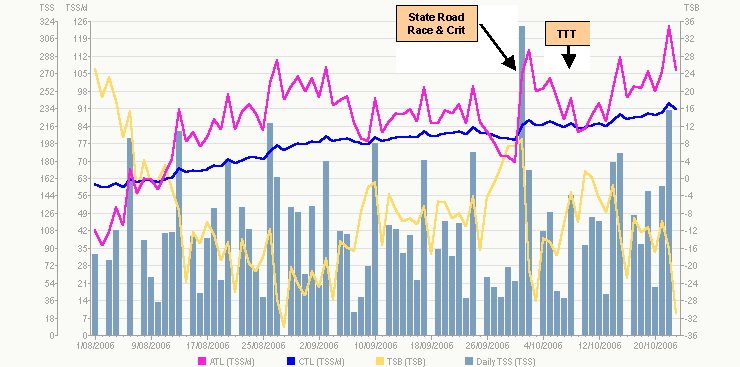
So, just to show that the PMC is more than a few letters strung together in random order, here's a picture of one (click on the pic to see a larger, clearer version):


This chart covers my training since 1 August. There are four items charted here:

TSS:

The light blue columns represent the level of training stress each day as measured by TSS (Training Stress Score), which is calculated from both the overall duration and intensity of a ride. The harder you ride, the more points you score and of course the longer you ride the more points you score. So it is possible to score more TSS on a short hard ride than a longer easy ride (and vice-versa). This is all calculated from the data collected by the power meters on my bikes and by some clever maths built into the Cycling Peaks analysis software I use (although you can also do it in Excel).

You will note the consistent blocks of training each week, with one day per week with no riding at all. The tall columns are the longer weekend endurance rides or races, with typical time constraints keeping mid-week workouts down in TSS levels.


CTL & ATL

The next two items to note are the Blue (CTL) and Purple (ATL) lines. These represent a measure of Chronic Training Load (the accumulated amount of training load over the past couple of months) and the Acute Training Load (the amount of training load over the past couple of weeks). So these two lines show a trend of what I've been doing long term vs short term. (The maths behind the calculation of my daily CTL & ATL involves an exponentially weighted algorithm which I won't explain here).


In this chart you will see that the blue CTL line rises steadily, in my case at approximately 3.5 points per week for the period shown.


Note also that the purple ATL line is a little more up n down. This is because ATL weights your most recent training more heavily in the calculation than is the case for CTL, and so even one big day on the bike, or a day off, will have a bigger impact on your ATL than it will on CTL.


So what?


Well in order to get fitter, we need to continually provide a training stimulus in order to gain the adaptation required for our riding and/or racing goals. This is tracked very well by the blue CTL line, which basically equates as a measure of Fitness.


ATL on the other hand, since it is looking at your most recent training, is more a measure of your current levels of training fatigue. If you've been going hard lately, then your ATL will rise, but if you have a recovery week, then ATL will fall.


Have another look at my chart where I mark the State Masters Championship Road Race & Crit - see
how my ATL falls in the week leading into the race as I have a short taper for the road race and coach had backed off my training.

TSB

Well with a reduced ATL I was quite fresh since my recent training was "easier" than what I had been accumulating long term. Hence the term, Training Stress Balance (TSB), which is the yellow line on the chart. So TSB is the difference between long term and recent training loads. Expressed mathematically it is simply:

TSB = CTL - ATL.
(A much simpler formula than used to calculate TSS, ATL & CTL).

Now this means of course that TSB can be either positive, negative or neutral.

Best performances are generally (but not always) associated with a positive TSB and hence it is desireable to plan training so that both CTL is high and TSB is sufficiently positive so that you have the two things that matter leading into an important event: Fitness and Freshness. Put these together and you will be going well.

Practical Example
So what about that race weekend? Well I went in after a steady build of my CTL, training was backed off in the week leading up to the race, which saw my ATL drop below CTL, hence going into positive TSB. In these circumstances, CTL falls a little as some "fitness" is sacrificed to be sufficiently rested and primed for the event.

The Result
In this instance I set new personal bests for Mean Maximal Power output for 60min to 2hrs, placed top-10 (7th) in a hilly road race (I'm no climber) and
set an all time power PB and placed 4th in the crit. Very successful outcomes given I only had a 2 month build.

There are many uses for the Performance Manager, and assisting a rider/coach evaluate a build and taper strategy that works best is one of them. It provides the opportunity to "dial in" peak performance on any given day.

Pretty nifty, huh?

Want to know more?

Go here.

Read More......

Sunday, October 22, 2006

Olympic Park Crit

Yesterday I competed in the Criterium at Olympic Park circuit. Photo of circuit here:


As you can see it's not a complex crit circuit - 915 metres per lap. Basically a flat, counter clockwise loop but on this cold (for Sydney) spring day there was a strong headwing coming up the wide and slightly uphill Olympic Boulevard making it a tough finishing straight.

I raced the same circuit a few years ago (only other time it's been used I think) and had a good day (took the prime and 3rd place as my mate rode to a solo win) but today the quality of the field was far higher.


Pace was pretty hot in Div 3. I was a might surprised actually and ended up setting a 20 minute Power PB in the first 20min of the race as I was trying to either initiate or get into an early break. Two riders managed to get away on a counter attack. I tried twice to bridge across, once with one other rider (who didn't quite have the legs - shame, we got to within about 10 secs) and again solo but that was futile as the bunch was more intent on catching the chasers than the leaders.

So a bit of "hide in bunch recovery time
" before a last ditch effort to grab 3rd place with a solo break at 2km to go but unfortunately I didn't quite have the legs to finish it off and was swallowed up in the finale just short of the line. Pulling 600 watts into the headwind was going to take its toll at some stage! Never mind - I had a crack and came away with a Power PB to boot!

Stats:

CTL: 89

TSB: -11

Pavg: 309 W

PNorm: 348 W

NZAP: 342 W (only 10% zero power time)

Last week's training saw a lift in intensity, with 2 days of hard 3-minute hill repeats and some time trial pace intervals mid week. Easing back a bit this week to consolidate power gains made in recent month.

Next week it's the Snowy Wilson Memorial crit at Heffron Park. Usually a team dominated affair, it will be another slug fest I'd say! Can't wait!

PS - I saw one other Power Meter user in today's race - Amanda Spratt, 2004 Junior World Points Race Champion. Amanda had SRM cranks/PCV on her rig. She was strong too, duking it out with the men in fine style. Go Amanda! Wonder what her file looked like? You can view Amanda's
Palmarès here:

http://www.cycling.org.au/Content/NavigationMenu/HighPerformance/RiderProfiles/FemaleRiders/Amanda_Spratt.htm

Read More......

Thursday, October 19, 2006

Team Time Trial and the Performance Manager


The performance manager is a killer tool for TTT efforts - and IMO would be the perfect type of event to illustrate the relationship between top end and TSB. A couple years back I did a few TTTs, some at positive TSB, some negative. The negative TSB TTTs were incredibly painful just to hit substandard Pnorm values...the positive TSB TTTs were as you say, exercises in restraint.
~ Dave Harris
A couple of weeks ago, three buddies and I contested our State Championships TTT (MMAS 2-4 category) on the constantly undulating Calga Course, about an hour’s drive north of Sydney. It was a late decision to enter, so no chance to get in a prior test run as a unit. There is a bit of a write up here and a couple of photos to boot.
Since three of the team are knowledgeable power meter users (including two members of the eweTSS PMC beta test group), I thought it would be interesting to see what the Performance Manager was telling us as a team.
If you want to know more about the Performance Manager, then this article on the Cycling Peaks site is a good place to start.

So who was where on the Performance Manager Chart curves?
Team CTL TSB
Peter 35 -12
Phil 82 +31
Stan 65 0 (as a rough estimate only)
Alex 84 –5
So before we started, we had a pretty fair idea of where we stood. Some sizeable CTL/TSB mismatches there.
Predictions anyone?

What the CTL/TSB mismatches really mean is that you'll probably have a better idea before hand as to whether you'll be the one doing the shouting or the listening!

Given the course in front of us was a hilly 43km out and back, FTP watts/kg was going to be as important as FTP alone (and we had a 22kg weight spread between us). Putting that together with the PMC data we knew/predicted/decided that:
  • Pete would be the sacrificial lamb

  • Phil would likely be ripping the cranks off and would have to be careful not to blow his mates
  • Stan we weren’t really sure about but he rode well in a test effort the week prior
  • Alex would be good but not as good as the weekend before when he entered the road & crit race championships with +ve TSB.
  • We thought had a chance of making the podium
So armed with that knowledge we already had a fair idea of how to attack the race.
So what happened?
  • Pete made it a little past half way (a fine ride if you ask me given his current weight disadvantage and low CTL).
    37 min; Pnorm 359W; IF 1.198
  • Phil was ripping the cranks off and basically had to hold himself back all day to ensure the team stayed as a unit.
    65 min; Pnorm 280W; IF 0.984
  • Stan did what Stan does best and rode a little hard early on, requiring some firm communication to bring him into line. He paid for it in the 4th qtr of the race (where his lower CTL perhaps was showing itself up). To be fair, Stan is the only one without a PM onboard to help him dose his effort.
  • I did what I could, felt like I struggled mid race but came good in the back half. Ended up with Pnorm bang on FTP but down on previous weekend’s peak.
    65 min; Pnorm 295W; IF 0.999
It was a fun outing and we came away with the bronze medal for our efforts (despite a slow change for Stan’s puncture – we did the maths, somewhere between 40-60 seconds lost or one step on the podium).


So in the end, the PMC was smack on in terms of predicting how we would go as a unit.
Lads on the podium.... (we're on the right)

Read More......

Thursday, October 12, 2006

Current Cycling Goals

    I am presently working hard to improve my cycling performance - my current goals are to attain PB performances in the individual pursuit and attain new levels of achievement in the points race at State and National Masters Track Championships in March 2007. Along the way I plan to perform credibly at the State MMAS Road and Crit Championships in October 2006.

    After that my main goal will be to back up with an improved performance at the World Masters Track Championships in October 2007, with the focus again on the IP and to make the points race final.

      Recent results include:

      2006:
      • Member of SCC Team at State MMAS Team Time Trial Championships: 3rd (Bronze)
      • State MMAS Crit Championships: 4th
      • State MMAS Road Championships: 7th
      • State MMAS Track Points Race Championships: 4th
      • Member of SCC Team at State MMAS Teams Pursuit Championships: 2nd (Silver) again!
      2005:
      • State MMAS Crit Championships: 3rd (Bronze)
      • State MMAS Road Race Championships: 4th
      • SCC A-Grade Champion
      • SCC Crit Champion
      • SCC A-Grade Road Race Champion
      • SCC Clubman of the Year
      • Snowy Wilson MMAS Crit: 3rd
      • Ken Dinnerville Memorial 90km open road handicap: 7th
      • Member of SCC Team at State MMAS Teams Pursuit Champs: 2nd (Silver)

      Read More......

      Wednesday, October 11, 2006

      Killing Nerves

      Below is a post I made to the Fixed Gear Fever forum. It was a summary of my thoughts and learnings so far about how to control nerves and anxieties before championship events.

      The full discussion can be found here at FGF:

      Like Spinal Tap - this one "goes all the way to eleven". :)


      I previously commented* on my first ever track race (teams pursuit) which was many years ago now but the nerves were mostly about not letting the team down. I didn't, 'cause once I was out there and you're going full-bore, well that's all you can concentrate on!

      Lesson #1:
      So from then on I knew, once the race started, any nerves I had before hand would usually disappear.


      * I remember my first ever track event - it was a teams pursuit. There was absolutely nothing left in my bowels before that race!


      We made podium with a 3-man team and gave the other teams with many current or former National and World Champion riders a shake. Being on the podium with a World Champion’s jersey standing next to me was building confidence (OK - I didn't know the world's jersey next to me was owned by a sprinter and not an enduro but that didn't mater at the time!).

      Lesson #2:
      Results built confidence and lessened my anxiety/nerves next time round.


      Since I was lucky to have success in a team event, this turned out to be the way in which I was best able to attain championship race results in the early years. Half a dozen team championship medals followed in the years to follow.

      Lesson #3:
      Team results built confidence more quickly for me even though as an individual rider I didn’t have the capability (yet) to attain individual results but I was able to contribute to team results – hence Lesson #2 came into play more quickly.


      Then I raced as much as possible to gain knowledge and experience in a wide variety of events, mostly 'cause I loved it so much but also it gave me a fair idea of what I was (i) best at and (ii) what I needed to improve and eventually focus on.

      Lesson # 4:
      My nerves have been lessened through sheer volume of racing. So get out there and get into it Alex!


      So after racing for a while, I improved and thought I'd start racing at individual championships, State and National (our States are pretty similar standard to Nats anyway). Well my first championships were fine - no nerves because I had no expectations of myself. But as the years progressed, I started to expect more of myself and there was a growing mismatch between what I wanted to achieve and how good I was at the time. That mismatch then fed performance anxieties which would start several weeks out and go right through to race time. That was probably the worst I ever felt. Championships were no longer enjoyable. I needed to step back, set realistic goals and remember why I was there in the first place.

      Lesson #5:
      I learned to set realistic performance goals. With realistic goals, my anxiety was lessened as success became redefined and more attainable. And remember Alex – “I do this because I love it”.


      In my racing, I began to introduce the idea of having a strategy, or at least some tactics to use in races. This I found was a great way to both improve and find out what I was actually capable of - races became more than just another race, it was a challenge to try something out and I was looking forward to racing even more. Importantly I had something positive to focus on before the race and I still got something out of a race that either I didn't win or perhaps was unlikely to anyway due to the level of competition. I also remember leading into an important race (an individual pursuit qualifier) having “brain fade” – result: I seriously underperformed compared to what I was physically capable of on the day (and I have the data to prove it)! That mistake was a great lesson to me about pre-race thoughts.

      Lesson #6:
      Now I will try to have a strategy/plan/tactics in mind before a race and replay them to myself - then I am focussed on what I want to do, rather than what I can't/shouldn't do. Takes up brain time otherwise used feeding nervous energy!


      I also realised that with support of others, nerves and anxiety could be lessened as you were both supporting your mates and as well as being encouraged to do well by them. I avoid the negative talkers. I do let this creep into my language at times, so some of my buddies now recognise when that happens and are pretty quick to get me back on track.

      Lesson #7:
      Hanging around riders with a positive and successful attitude, created a similar thought process and helped reduce my nerves.


      So then I began to understand the individual events better and started to simulate the racing stresses in training. I had a coach guide my conditioning. I earned coaching qualifications myself. I ventured (enthusiastically) into the world of training and racing with power meters. Suddenly I knew the demands of what I was aiming for and where I was currently - I had a road map of how to get there. Then after following the map - I had a breakthrough, an individual podium result at championships. I record important data and make full use of the fantastic tools available for tracking performance (e.g. Cycling Peaks WKO and Performance Manager) - the lessons and data collected are invaluable aids and help me focus on what's important. But caution – it takes time and experience to properly interpret the data and you can draw the wrong conclusions (but don’t be scared to make mistakes – we learn more that way).

      Learning to make use of the new tools available for tracking and managing performance / training is giving me confidence in my conditioning and training (especially the data from power meter). It means I’m learning to determine beforehand what I’m capable of and how to get the most out of what I’ve got. Reminding myself of this before races helps me.

      This last one is getting better and more important for me with experience and a growing bank of historical power data. Only last weekend I was able to confidently predict my form on the day, which was a significant contribution to wringing the most out of myself (through appropriate pacing) and earn yet another team championship medal (this time a road TTT).


      Lesson #8:
      If I can, I try to simulate race conditions beforehand in training – then on race day they seem normal and I can remind myself of the fact, e.g., “Pace the first lap and a half just like in training”.


      Lesson #9:
      Learning to read and predict my own form has reduced my fear of the unknown. I now know pretty much what I’m in for before I start (and how that might influence my strategy in a race).

      Lesson #10:
      I realised over time that some pre-race nerves are good and are normal (so I am used to feeling that way as I know it means I have the right level of arousal). It might be slightly counter-intuitive – but I get worried when I don’t get a little nervous before a big race!

      Lesson #11:
      I’ve realised that I must make sure I don’t forget to have fun, celebrate and have a good laugh at having been nervous in the first place!

      Read More......

      Tuesday, October 10, 2006

      Aerodynamic Drag Testing Using a Power Meter

      Earlier this year, with the assistance of Dr Andy Coggan, I put together a protocol and spreadsheet to assist those with power meters to undertake their own aero drag testing.

      The sheet can be found at the trainwithpower.net site here:
      CdA-Crr.xls

      All instructions are contained within the Excel file. Thanks to Charles Howe for developing the trainwithpower site and hosting the sheet.

      The online discussion at the Fixed Gear Fever Forum can also be viewed here:
      FGF Forum Discussion on aero drag testing

      Enjoy!

      Read More......

      TTT


      Last weekend, 3 buddies & I competed in our State Team Time Trial Championships. We were entered in the Masters 2-4 category. Here we are early on - with Phil having just peeled off and Stan surging a little hard, some shouting was necessary. Pete was following my wheel and was our sacrificial lamb for the day (he's only just started back into training - otherwise I'm sure he'd be tearing our legs off).

      The idea was to have a fun outing, given it would be the last chance for us to all ride together as a team (we are all leaving our club and moving on - but that's another story).

      Well we came away with the bronze medal, despite time lost through a puncture change, so that was a pretty good result. I'll post some data and thoughts on power files and performance management data later on.


      Phil, Stan & myself on "Blood Hill" a few km from the finish. This nasty 2 min hill saw me punching up at 390W. Stan was struggling a little by this stage but we got there!

      Read More......

      Power to the People


      For those that have seen my posts to the various online cycling forums, they will know I am an advocate of training with power. I plan to use this blog to better record my progress and share learnings along the way.

      * I am also an advocate of riding bikes too, especially racing, so commentary may digress into related subject matter.

      Read More......