Monday, August 25, 2008

Team Bicisport

Shane Sutton must be pretty pleased with himself at the moment. The Aussie and former Commonwealth Games Gold Medallist is head coach of the Great Britain track cycling squad and has overseen their rise to a remarkable dominance at the Beijing Olympics (and the most recent World Championships). It was great to watch all those world beating performances and the world records by the Team Pursuit and Team Sprint squads were tremendous. The bar has well and truly been lifted.

I coach myself, mostly individual riders but at times I help out with squads. Over the last couple of months I've been helping out with my own club's (Bicisport) efforts at the State Team Time Trial Championships. It's a great event to participate in. Four riders work together to complete the 40+km course in the shortest time possible. Just like the team pursuit, it is the time of the third rider across the line that matters.

Our club fielded five teams, all in the Masters racing categories. Two womens and three mens teams. The race was yesterday.

All the teams rode very well, with no mishaps. The women went one-two but unfortunately only two womens teams qualified to ride, which was disappointing.

The big result came with our MMAS 1-4 squad (under 50's), who won the championship in a time of 1:01:30, with a margin of only four seconds to the second place Manly Warringah team. I believe that is a course record for Masters. Team2 were one minute off the podium in ninth place and our MMAS 5+ team were eighth in their division. Unlike the women, there were 40 teams in the Masters mens.

A winning combination:
Ian, Phil, Mike, Alex (coach) and Jayson

It was great to watch them ride, with the key elements of team work showing through.

A big thanks to Mike O'Reilly for getting much of the logistics sorted. Nice work Mike. Also to all the others who helped out and riders that supported the training efforts.

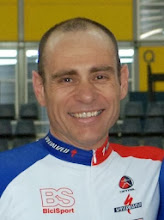
The photo at the top is of the winning squad with me on the right showing off Schooner II. For my mate Phil, this was his 12th attempt at the event. Persistence pays off! Well done lads, a great ride.

As for me, well training had to take a back seat for the past week and a half. I was beginning to have some problems with my leg stump - a kind of bruising type of pain and it was aggravated when I rode and hurt when I walked. Not good. I thought it might go after a couple of days of rest but it didn't, which got me down a bit as I was going along really well with my training.

I called my prosthetics guy (George) last week and arranged to go and see him today and we talked it through. It would seem the solution is about the way I am using the socks that go over my leg liner. I won't bore you with the details but I now have something to try. I mocked up a sample of what I need and then did a 30-minute trainer ride this afternoon. Got through that no problems, so will get back to training again now.

George looked at the way I walked and could see the dramatic improvement in my gait from last time.

Everything is new again and I keep learning about the challenges along the way. I have said before, the mental challenge is the hardest part. Recognising what's important now and doing what you can do now to get to the next step is what matters. I can be a little hard on myself, which is OK when you are trying to train hard but I also have to temper that with the realisation that losing a leg ain't no small deal and in reality I am doing well.

Read More......

Monday, August 11, 2008

Benchmark

OK - a couple of pics for your viewing pleasure. Here I am on he start line about to do a 500 metre time trial at Dunc gray Velodrome on Friday night 8th August.

That's Brad Cox (Lionel's son) doing his best to lift my considerable mass off the ground so I can get the pedals in the right place for a start.

Normally I'm a natural left foot starter, so I need to re-learn the start using the right leg. I suppose I could try to start with the prosthetic leg but the forces are highest on the first push down and I think using my good leg first makes sense.

On my first start attempt I pulled my prosthetic "foot" out of the pedal so I had to roll around for a second go. No issues second time out of the blocks. You can see the way the pylon of my leg attaches directly to the pedal. It is like having a pedal cleat placed directly under your ankle, just forward of the heel.

And here I am at some stage on my way to a world of suffering as I try to hang on after lap 1.

Lap 1 was OK, not quite as fast as I thought I might go, but it's a start and I can only get better from here.

Lap 2 was pretty forgettable, I really tried to keep it going but I have no anaerobic endurance whatsoever (understandably) and well it wasn't a pretty sight. But I finished OK. 46.something seconds.

Track TTs are not my favourite event. But the skills involved are crucial for good trackies, so I'll keep trying to improve on that and all the other aspects of track riding.

I have been thinking about the pedal security issue (really important when riding in general but especially critical when on a fixed gear track bike - believe me I know having previously suffered a broken bone through pedal failure).

I sense a different feel when out of the saddle acelerating. The motions are different, the firing sequence is a bit different and so I'll need to re-learn so that it becomes natural again and can give it a maximal effort with confidence.

Since there is no longer an ankle on my left side to naturally manage the sideways forces caused when the bike is rocking side to side, when I push down on the left it tends to straighten the bike up more than normal - but only on that side. If I use the upper body to create the opposing force, then I get that feeling I might be putting too much lateral force on the pedal which might cause it to disengage.

So I was think of experimenting with a hard rubber bushing at the cleat to give that little bit of natural side ways flex so that the foot can pivot sideways slightly on the pedal before it attempts to disengage.

It's just another idea to play with. Each step along the way throws up new things to consider and I learn something new each time. In a weird sort of way I'm rediscovering the pleasures as everything on the bike is new again.

Other than that, it's not complicated. Just get on and pedal. Hard. For as long as you can.

Read More......

Sunday, August 03, 2008

On Track

This morning I had not intended to ride as we had our club Team Time Trial training session scheduled up at Calga/Peats Ridge (which I am supervising/coaching). That went well. When I got home, well it was such a glorious winter's day, clear blue skies, light wind and about 17-18 C, so I decided to throw the bike in the car and head on down to the park for a roll. Back to that later.

On Friday, the planets aligned for me and so I had the opportunity to dust off the track bike (poor thing, it's been badly neglected), get down to DGV and get myself on the boards for the first time since my accident. So I circulated no problems. Saddle height needed an adjustment (I had installed slightly shorter cranks so the saddle needed to come up a bit). About 30-minutes of rolling around just reacquainting myself with the boards.

Then it was time to see if I could do the sort of stuff I'll need to do when riding on a track - namely accelerate, hard!

I rode up the banking to do an acceleration down the banking, which I did without incident.

So then I rolled slowly along the front straight and then popped out of the saddle and tried an acceleration. OK, so I wasn't going to set the world on fire but I was able to do it and that was the main thing. One more half lap effort, this time a bit harder and out of the saddle for the whole turn and down the back straight. There sure is a bit of re-wiring needed and the sensations are difficult to explain. Some stuff is the same, some I need to re-learn. Practice Alex, practice.

While I was there, Sean Eadie (2002 World Sprint Champ) was there coaching a Chinese rider. So I got Sean to time a standing 250 metre lap. 24.9 seconds. But the nice thing was simply being able to go out of the saddle for more than half a lap.

So back to today. My legs were a little sore but after a couple of laps they came good and I ended up doing a solid hour and a bit. That then gave me a 5-day block of riding and a nice little boost to my training loads. That blue line is on its way up :D


I also tried something new - putting an extra sock over my leg liner before riding, which provides addition compressesion of the leg stump inside the socket. This had the effect of maintaining a more secure fitting, not allowing the leg to sweat as much and so there was not much pooling of perspiration in the lower part of the liner creating that insecure squishy feeling. So that was pretty cool.

I'm going to sleep well tonight me thinks!

Read More......

Wednesday, July 30, 2008

Two by Twenty - Take 2

Way back I posted about a workout known as the 2 x 20. It's pretty simple. Ride for 20-minutes at around your time trial pace/effort/power, have a short break and then do it again. Combined with a warm up and cool down, it makes for a nice tight one-hour workout that's exceptionally effective at developing one's aerobic engine.

On a power meter chart - it looks a bit like this:


The squiggly yellow line denotes power output and was around 200 watts for two efforts lasting around 20-minutes. The horizontal dashed line shows 200 watts.

In between efforts I stopped and hopped off the ergo bike to remove my leg and dry the liner and leg, and replace so I could go again. It's a challenge I face at the moment as the leg liner tends to fill with perspiration making it a little weird to pedal. Imagine pedalling in loose gumboots with water in the bottom of them.

Of course there is nothing magical about 20-minutes. Overall it's about getting enough time at these levels. Some do 3 x 20-min. Others 3 x 15-min. Some ride the hour straight at that power. Typically though we break up efforts into smaller duration "chunks" (known as intervals) so that we can maintain perhaps slightly higher power than we may otherwise have the motivation to do all in one go.

So what's actually happening when I train at this level? Well lots of good things. The main physiological changes that are brought about by riding at these intensities include:

- increasing my muscle glycogen storage capacity. Glycogen, along with free fatty acids are key sources of chemical energy which is converted by our muscles into mechanical energy (and heat). Basically this means I develop the ability to ride hard for longer.

- increasing muscle mitochondral enzymes - these are the "mini power plants" inside our muscles, which use the available oxygen for the conversion of chemical energy to mechanical energy (as well as heat). The greater the number and density of these suckers we have the better

- increased lactate threshold - which is another way of saying one can go harder for longer. Blood lactate concentration is one way of determining how effectively our working muscles are performing at various intensities.

Now you gain these benefits by riding at lower intensity levels as well but the rate at which improvements occur is greatest at these intensities, which is an effort level equivalent to how hard you could maximally sustain riding for about an hour.

They are also effective at increasing my blood plasma volume, increasing my heart stroke volume (amount of blood moved per beat) and maximal cardiac output (maximum amount of blood I can pump per unit time) and for increasing the amount of oxygen I am capable of both delivering to my working muscles and actually utilising (my VO2 Max).

There are other funky things too, like increasing the density of blood carrying capilliaries inside the muscles - which enables a greater and faster transfer of oxygen to the working cells. On top of that, our (slow twitch) muscles fibres also grow.

The body is an amazing thing. It knows how to adapt when it is provided with a training stimulus. The trick is to keep providing that stimulus in the right doses.

Read More......

Saturday, July 26, 2008

Birthday Bash

It's my birthday today!

So what does any self respecting bike rider do on his birthday? Race of course!!

Last week I reported on my effort at a local criterium race, which did me in before 10 minutes had passed. This time it wasn't so bad and I lasted 30 minutes before withdrawing gracefully.

I had a lap out for "leg mechanical" and then rejoined for a lap but lost my momentum and decided I'd had enough and had done what I'd set out to do (which was to show I can get around OK in a race). It's a bit tricky with the leg, the liner I use fills up with (yuk - wait for it) sweat and it gets a bit squishy to pedal when it's like that. The liner also tends to slip down the leg a bit. So I pulled off to the car quickly to remove the leg and liner, dry them off and put them back on again. It's probably not technically a mechanical but I don't think the race officials are too worried!


Here is the race file with 30-second smoothing.


Heffron Crit D Grade:
Duration: 32:30 (34:56)
Work: 354 kJ
TSS: 57.9 (intensity factor 1.035)
Norm Power: 207
Distance: 18.457 km
Min Max Avg
Power: 0 747 182 watts
Speed: 3.7 45.9 34.1 kph

With my warm up / cool down, that was a 97 TSS day and so that was plenty. I was a little stiff 'n' sore from last week's race, so no doubt I'll feel this one as well in the coming days. But as they say, the more you train, the more you can train.

Proof is in the pudding, so to speak. Here is my training since 13 June:


My chronic training load is just a touch shy of 30 TSS/day.

I also did a MAP Test during the week. 289 watts. That's about 70% of my prior accident MAP level. I'm also ~ 20% heavier at the moment, so on a power to weight basis, I am classed as "untrained".

I upgraded my crank length twice this week. I tried a 165mm left crank arm earlier in the week, and yesterday I did an easy spin on the ergo with a 170mm crank. That was OK once I'd lengthened my leg a bit, so I put that crank on the race bike and that's what I rode today.

This is very cool news. 170mm is the crank length I use on my track bike, so I have already attained a range of motion sufficient for that, and my normal road cranks are 175mm. So I think in essence I have developed sufficient knee mobility for cycling. It still needs to improve but it's a lot better than it was.

From hereon it is about improving the functional performance of the leg, some weight loss through increased training and diet control and developing the aerobic engine required to drive me faster and put the hurt on a few guys.

Tomorrow is the State Time Trial Championships, so I'll be heading up to Calga to support a few of the lads who are riding.

Read More......

Saturday, July 19, 2008

Race Report

Just a quick post today. No pictures.

I had a race today. One month after I gingerly first turned a crank on the trainer and nearly 16 months since my accident.

I drove on down to the local crit racing circuit at Heffron Park. No idea what grade to ride, I decided to start in E and if that was too easy then I'd pull out and wait for the D Grade to start. Well it turned out there was no E grade so I lined up for D grade. On the line I was seeing if I could do a track stand while we were waiting to start. I could. Geez - it's just like riding a bike.

Chatted with plenty of the guys beforehand and had to laugh at Jason Roberts who, when he saw me lining up and checking out the leg, called me "f***ing hard core man". I suppose that's one version of HTFU! Jason is one of those guys that could audition for the Hulk stand in job.

Before that I did some laps of the circuit to remind myself of those familiar bumps and turns. I also surprised myself by being able to do some pedal revs while out of the saddle. It's not pretty and I'll need a fair bit of work on the technique but it's a start.

As for the race, well not all that much to report really. I lasted 5km before being dropped, simply not enough horsepower to manage the (relatively light) surges of the D grade bunch but I'm not that far off D grade standard, so I have a reasonable benchmark to work from. After that I just circulated solo for a good 45-min training effort.

I had a little trouble as the new chain I have on is showing up the state of the chainring and under load it would skip most annoyingly and when I was attempting to pedal out of the saddle over the small rises, the chain would jump - it was hard enough controlling things as it was and it took a bit of care as I was putting my spokes into one guy's dereilleur at one stage. Will need to attend to that. To be fair, I think I'm due for a new race bike, there were that many creaks and groans coming out of this one...

Here are the stats for the day:

Crit Heffron D Grade:
Duration: 47:00 (1:06:06)
Work: 552 kJ
TSS: 96.5 (intensity factor 1.11)
Norm Power: 205
VI: 1.05
Distance: 24.462 km
Min Max Avg
Power: 0 748 196 watts
Speed: 3.7 44.9 31.2 kph


Entire workout (173 watts):
Duration: 1:15:55 (2:25:26)
Work: 786 kJ
TSS: 138 (intensity factor 1.047)
Norm Power: 194
VI: 1.12
Distance: 35.626 km
Min Max Avg
Power: 0 748 173 watts
Speed: 3.6 44.9 28.3 kph


We shall see what happens next week!

Read More......

Tuesday, July 15, 2008

Off the Air


OK - I've been off the airwaves for a little while. I was changing my internet service provider and that turned out to be a small pain in the butt but I'm back on line now - so time for an update on a few things.

Firstly, the above chart tells a pretty cool story so far. Each of those light blue columns is a day where I have ridden on the bike/trainer. The height of the column indicates how much stress I incurred on that ride (a combination of duration and intensity) and the dark blue line indicates my long term training load, curently at 23 TSS/day. Basically my objective for the coming weeks/months will be to keep training in a way that sees that blue line continue to rise at a sustainable rate.


In the one-month since first turning a crank over on a home trainer, I have:

- ridden on 23 of those days (mostly on the home trainer)
- progressed to using a 155mm crank on the left side (I started with a 100mm crank)
- had my special bike leg attachment fitted
- had two rides outdoors on my real bike
- been able to sustain 190 watts for an hour
- for the first time tonight I was able to do a couple of pedal strokes while standing up.

Here is the power file from my 1 hour ride in Centennial park on Sunday morning. I think an average power of 180+ watts for an hour with an average speed of nearly 30km/h ain't going too bad all things considered.


I was considering racing a crit this coming weekend but I just remembered I have some commitments (coaching at an intro to track session on Saturday). Might take the track bike out though and see how that goes....

Read More......

Wednesday, July 02, 2008

Inspector Gadget

OK - another pictorial adventure coming up for your viewing pleasure.

I recently reported on getting a dedicated bike leg attachment made up. Some aren't exactly sure what that means, so let me show you....

First we start with the leg I have today, set up as a normal walking leg.


If we zoom in to look at the special clamp at the bottom of the socket (the large black carbon fibre part that my legs fits inside of), you can see a number of allen key bolts secure the pipe section to the socket.


These can be loosened to remove the lower pipe section which has a foot attached at the other end.


Here you can see the two parts normally hidden from view, showing the unique block style clamping system. There are four of those allen bolts, one on each side and they enable you to adjust the angles at which the pipe section fits onto the socket.


As long as I only ever undo two of these bolts (must be next to each other and not opposite) then the attachments will always clamp back on in exactly the same place each time. If I loosen three bolts, the the positioning changes. Hence I have put some loctite on the two bolts I don't intend to undo.

Here is a picture of the walking foot attachment and my cycling "foot" attachment. As you can see, there is no foot for the cycling leg. It is simply a pedal cleat attached to an adapter plate right under the end of the pipe. This enables direct force transfer down through the leg, the socket, the pipe section and onto the pedal.


Here is a picture of the cycling leg attachment connected to the socket.


On Monday I visited my good buddy, Steve Hogg at cyclefitcentre.com. Steve specialises in fitting bikes to people. So away I went and we worked on getting the bike leg attachment adjusted for length and all the multitude of angles you can adjust. Indeed it's almost as if there is too much adjustment available!

The best part was that we discovered that my knee was able to cope with using a 155mm long crank arm. At the moment I have a short 100mm crank on the bike, as I hadn't been able to bend the knee enough to use a longer crank. On my road bikes I normally use 175mm cranks and on the track I use 170mm. So my leg has improved enough so that I am not far away from using a full length crank.

That is really important as it means I will have a much greater ability to get power through to the pedals.

All I need now is a 155mm crank arm. I have a buddy looking into that for me (he made the short crank up for me), although I know there are manufacturers of cranks that small, normally designed for BMX riders, so I'm pretty sure finding one won't take long.

Then I expect to graduate to 160mm, 165mm and hopefully at least 170mm cranks.

Ultimately I would really like to have a dedicated cycling socket, so I can simply transfer from a walking leg to a cycling leg without having to bolt things on and off. Also, the design of the walking leg socket is not quite ideal for the way I pedal the bike - there are a large number of dynamic factors at play but basically the lower socket shape angles outwards when it would be better if the line between the knee, lower socket and pedal was aligned. It will certainly do for now though.

The best way to make sure that happens is to keep riding!

Read More......

Saturday, June 28, 2008

Thunderbirds Are Go!

Meet Thunderbird 7:

T7 resides in the spare room, specially cleared out for the purpose.

This new "space age" home built trainer is now set up for some serious workouts. Note the cat killer of a flywheel. Fortunately I don't own a cat. There is a safety cover, it's just not on there yet.

T7 also has inbuilt position adjustability in any direction you like. So I can use it for testing other cat lovers. T7 originated in the minds of some residents of "The Shire", so you can be assured it has some magic about it.


The flywheel gives a very realistic ride. I did my first short workout on it tonight and it felt great. I was able to tap out a much higher cadence and power than on the turbo trainer. A 30-min workout with an average of 169 watts.

The fan blades replicate wind resistance and give a nice cooling breeze as well.

The crank system is an SRM power meter. My buddy Pete helped install it for me. Well actually he installed it and I watched (my definition of helping can sometimes be a bit liberal), although it's not that difficult. But installing an SRM properly requires the right tools and a calibration kit, which Pete has and I don't (well not all the tools - a good torque wrench being the main missing component).

Also note the short crank on the other side. Over time I expect to be able to lengthen the cranks I can use until I'm back to a normal length crank. Next week I get my special bike leg attachment fitted.

The SRM crank then drives a Nexus hub, with an internal 7-speed gearbox (normally built into a rear wheel for commute style bikes). The Nexus hub then runs a chain to the flywheel. This "double reduction" gearing enables the flywheel to turn at very high speeds (in the order of 600 rpm), meaning the fan blades do their job by providing increasing wind resistance with an increase in speed and the rotational intertia of the flywheel replicates the inertia of a rider rolling along at speed.

Here is the T7 flight cockpit:


Ready when you are Virgil....

Read More......

Thursday, June 26, 2008

Hippy Hippy Shake

On Monday I had a new prosthetic foot attached to the end of Schooner MkII (although some of my Aussie friends suggested I rename him "Middy" due to the smaller capacity of the new model).

The foot is quite a complex bit of engineering and is full of carbon fibre plates and other adjustment pieces you can't see and which replicate much of the feedback you get with a normal foot. You can actually "tune" the foot to provide different levels of feedback.

The one function that is obvious to the eye however is the fully moveable ankle joint. This special ball and socket joint replicates much of the joint motion of a normal ankle. It will move in any direction as well as rotate slightly.

This is so much better to use than the fixed ankle I did have as my foot can now move with the variations in slope and camber of surfaces I walk on. Slopes and cambers on a fixed ankle are a right pain in the butt (well back and hips to be accurate).

It also means that my walking motion is progressing even closer to a natural gait.

This is the foot in its normal upright position:


And here it is with my foot out to the side, shoe flat on the floor and leg now at an angle - just like a tennis player ready to receive a serve or a soccer goalie waiting for the penalty shot to be taken.

It is rated to cope with the forces my current oversize backside will put through it but I hope to stress it less over the coming months as my training ramps up.

These things are not cheap however. All up that's now a $12,000 leg. And I'll no doubt need a modified dedicated socket for cycling. I have the pedal attachment sorted and I go in to have all the bike fitting done this coming Monday.

More on that (and my indoor cycling ergometer project) later.

Read More......

Friday, June 20, 2008

Da PMC is da goods

What the? Nevermind. ;)

My re-introduction to training continues, this time with a 30-minute effort on the bike trainer this morning. So, I have ridden on the trainer six out of the last eight days.

This is shown in the chart below, which assigns a "training stress" score to each day's training as shown by the light blue columns.


The number shown bottom right is my "Chronic Training Load" an indication of how much training I've been doing over the last several months.

Not surprisingly, a CTL of 4.2 TSS/day tells me I've not done much training! Consider that my peak CTL for the last season I raced was 100 TSS/day and I have a long way to go!

But the good bit is I've been able to increase what I do on the trainer through the week, and the half-hour effort this morning is starting to get into the realms of useful aerobic training. I was watching some TdF highlights while riding. 2006 when Floyd Landis cracked on the climb to La Croix de Fer. I wasn't on the bike long enough to see it finish but Rasmussen wa on a solo break away, with Levi Leipheimer pursuing.


Speaking of Rasmussen, check out this You Tube clip of a commercial featuring Rasmussen. It's pretty funny. But you gotta understand why. It's not in English (well not much) but anyone who follows cycling will get it.

Here is the pic of the power meter file for this morning's ride. 144 watts total and a 20-min max of 156 watts. I reckon that's a pretty encouraging start to my training.


Bring on that new cycle leg attachment and look out!

Read More......

Monday, June 16, 2008

Just a little bit more


Well that chart above just about says it all. A 20-min effort on the trainer today and a little harder than on Saturday. Last 5-min at 158 watts.

It will be really interesting to see what difference being able to click into a pedal will be like with the prosthetic. At the moment just plonking my prosthetic foot/shoe on top of the flat bed pedal, while OK on a trainer, doesn't do much for power. I have been placing my "heel" on the pedal to simulate the position the pedal attachment will take.

And I have a suspicion I might be able to try a longer crank than the 100mm shorty I have on there at the moment.

First time in 15 months I've got the HR moving!

Read More......

Friday, June 13, 2008

15-minutes of fame

Not much to say other than since I have a new leg, I thought it about time I tried to turn a crank over on the bike (on the home trainer).

Here is the file from my 15-min effort.


A combination of very low fitness, new leg, pedalling a 100mm crank with a flat bed pedal on the left and my normal 175mm crank on the right. Combined with the PT's aliasing "feature" it makes for a funny saw-tooth power line.

Anyway, who cares what the line looks like, it was a ride right? :)

I was pretty sore before starting as the day before I had been on my feet a lot and actually managed to climb a couple of flights of stairs with full leg steps and no hands to guide me. That's something I haven't done for over 14 months... I think the ride loosened me up a bit but here's hoping I can start to get those exercise endorphins flowing before long.

Still working on the bike leg attachment.

Having done this 15-minutes though, I have the feeling a dedicated bike riding socket will be in order as I suspect some subtle (maybe not subtle) changes will be needed to the socket design. Time will tell.

Read More......

Monday, June 09, 2008

Schooner rides again!

I have a new leg. Finally!!

So today will be lots of pictures of Schooner Mk II - the new and improved version.

I went back to see George at the Appliance and Limb Centre last Wednesday and have now picked up the final product. And what a relief. After only a few days, already the pain and discomfort of using Schooner has gone.

The new leg is very comfortable but it is also provides a far greater freedom of movement for the knee. Hence I am not super steady on it yet and I need to build up the strength required to walk with a natural gait and improve the finer balance control that we take for granted. That will come with use and exercise.

So here we go with the picture tour....


Of course this is all in fashionable black and the socket is carbon fibre. What else for a post modern cyclist?!!

Notice the shaping at the top of the socket in particular. This is a unique design, in the sense that it is completely custom made for me but also in the sense that this style of socket is only made by one person in the world. There are only six of these socket types in existence!


The big difference in this design from other sockets is how low cut it is. This is to enable a lot of freedom of motion for the knee joint (which is exacly what I'm going to need when riding).


Here is the lower section connecting the socket to the foot.


Inside the socket, of course, goes my leg. But my leg has to have two special liners "rolled" onto it first.

The first, the "Distal Cup" is not shown and is a silicone like cup shaped liner that sits over the lower part of my leg. It creates a uniform shape out of the lower part of my leg.

Then this lovely lilac liner is rolled over the top. It is like a thick compression sock, with a metal pin sticking out the bottom.


Here is a shot of the pin - see the shape - it is designed to "click" into place and the notches hold the liner and via that, my leg, securely into the socket.

I then put the leg inside the socket and the pin fits through a hole in the bottom of the socket and clicks into place. Max of seven clicks!


When I want to remove the socket from my leg, all I do is press this button in and the pin is immediately released and Schooner MkII comes off instantly! No stuffing around holding onto liners and using my other foot to pull Schooner off and wince as the socket compresses my knee joint on the way through.


And this is what it looks like when I stand in it!


Next up are two more projects:

- Finalising the cycling leg attachment, and

- Getting a funky new prosthetic foot attachment, with a ball and socket which simulates the motion of the ankle joint.

These are happening over the next few weeks.

Read More......

Sunday, May 25, 2008

A Crafty Bugger

When Schooner Mark II arrives (due sometime in the next week or so), then I not only have the challenge of learning to walk on the new leg (which shouldn't take too long) but of also rigging up and adjusting a new cycling leg.

As mentioned before, the new prosthetic leg has been designed to enable a fluid pedalling motion by allowing sufficient freedom of movement around the knee joint (especially behind the knee). It is that very freedom which means I will take a little time to re-adapt to walking on it - my knees, hips and all the associated muscles, tendons etc need to have the ability to cope with the new level of freedom. That will mostly be sorted out simply through using it and maybe a few supplemental exercises.

The prosthetic is also designed so that my walking foot extension can be readily removed from the leg socket and a cycling leg extension attached. Undo/redo a couple of allen bolts to drop one out and put the other in.

Getting it right requires a few planets to align, with one of them just being put into the right orbit today.


At the moment the problem is being tackled from each end of the prosthetic - firstly the end where the remainder of my left leg attaches (fits into) to the prosthetic socket. That's been the job of my prosthetics specialist, George. I'm going to write more about that when I get the new leg.

The other end is the interface with the bicycle pedal. I still want to be able to use the standard clipless pedal system for all the normal advantages that provides (for the non-cyclists amongst you - that's a pedal system whereby a cleat on the bottom of your cycling shoe enables you to "click" into a pedal, which then holds your foot securely onto the pedal, similar to how a ski boot is secured onto a ski).

I also did some research which indicated that riders using prosthetic legs have had two main approaches to using pedals. One has been to use their normal prothetic foot (or a proxy prosthetic foot) and wear a cycling shoe on that. This has some inherent problems, as there no longer exists much of the lower leg required to stablise the foot section and the lever it creates puts non-radial forces through your leg to socket interface. The other approach is simply to place a cleat directly under the end of the pipe section that extends down from the leg socket.

This latter arrangement is effectively like pedalling with a cleat attached under your heel. That means that forces are applied in a line that goes directly down through your prosthetic socket, straight down the pipe section and into the pedal. This is radial alignment is also the strongest arrangement, and since I have no foot on that leg, there are no toes to overlap the front wheel (which is why you could not position a cleat as such with a normal foot).

But hang on - isn't that going to do some weird things with my pedalling action and balance considering my other foot will use the standard shoe/cleat and pedal position?


Well of course it will, but not as bad as one might at first think. The one advantage of a prosthetic leg is that I can make it as long or short as I want. It can be made to extend out at any angle I desire. The cleat can be moved fore/aft, side to side and rotated in its own plane, so there are significant types of adjustment should it be required. Indeed there are also shims that would enable the cleat to be slightly rotated perpendicular to its plane if that were necessary.

OK, so how about shifting that planet's orbit to make it happen?

In steps my good buddy Peter Barnard and all his crafty machining and cycling nouse on how to design and manufacture a solution for me.

The challenge was to fashion an adapter so that a cycling cleat with a standard 3-hole fit like this slightly worn Campag cleat:


could be attached to a standard attachment block used for prosthetic legs:


Here are some pics of the solution. This is the adapter plate Pete fashioned up:


Note the overall shape and how it is designed to be flat on one side for the prosthetic attachment block and curved on the other to match the curve of the cycling cleat. Also the attachment of the prosthetic block requires four screws in a square arrangement and the cycling cleat requires three screws in a triangular arrangement.

The way the design is made is so that two of the prosthetic block screw holes were able to be lined up with two of the cleat attachment holes (which was simply fortuitous), so that enables all three to be securely fitted together with two nuts and bolts and reduces the overall number of screws needed by two.

So, attaching the prosthetic block on one side:


and attaching the cleat to the other side:


and it all looks like this when together. From side on:


and head on:


So that's either end of the planetary orbits being sorted out. Now I need to work on some of the middle planets. There are quite a few, not least of which is the limited flexion of my knee joint at the moment!

Read More......

Thursday, May 15, 2008

Prototype

Today was the day I was going in to to get my new leg. Or so I thought. As it turns out, I hadn't anticipated or realised (or asked or was told) that there was another intermediate step to the process.

This involved testing out a prototype of the leg with a socket made from a transparent plastic of some kind. Clearly it makes a lot of sense to test out the fitting with a prototype and not the finished product, so I feel like a bit of a dill to have not realised this.

It meant that the socket could be fine tuned to suit all of the individual characteristics of my stump/knee/tendons etc. It is very interesting to note how many elements go into getting the socket to be sized and shaped precisely to meet your individual needs, and then for the pipe section and foot attached below to be adjusted so that your gait is strong and as fluid and natural as possible.

My hips have weakened and so I need to do a little strength work on them, but apart from that I seemed to be able to use the new low-cut style socket quite well. I will likely need to use a crutch or walking stick as an aid in the first days/week as I develop the natural strength and motor control skills required.

So while I am disappointed that I don't have my new leg just yet, what I do know from the session today is that the use of the new system (distal cup and liner with the pin and socket arrangement) is significantly more secure and comfortable than what I currently use. This is good news since over the last week I was becoming a little anxious about today's session. My main concern has been whether the discomfort and pain that I have been experiencing over the last two months would go away with the new leg. That would appear to be the case.

It should be about another two weeks for George to complete the new socket. So the saga continues....

Read More......

Friday, May 02, 2008

The seven deadly sins

This will be old hat to anyone that's been around the world of training with power meters for some time. However, having monitored the cycle training forums lately, it seems the question about how to estimate a rider's Functional Threshold Power (FTP) is something that comes up quite regularly.

So I thought I'd write a post about it in the hope that it will at least help clarify one or two things for people.

Before I go into the various methods used, it's probably worthwhile quickly revisiting what FTP is and why it is important to know.

FTP is a practical and readily measurable indicator of a rider's aerobic fitness. It was introduced to the world by Dr Andrew Coggan and for all intents and purposes it removes the confusion that exists over the term "threshold" and all of the various terms associated with it.

It is important to know FTP for a number of reasons:

-- threshold power is the single most important physiological determinant of endurance cycling performance (covering events from individual pursuits of 2 km long, up to stage racing lasting several weeks). Hence improving FTP needs to be the primary focus of our training, and measuring FTP on a regular basis is an excellent means of tracking fitness changes through the course of a season.

-- it enables a rider to define and measure intensities of riding (or power levels) relative to their own current level of fitness, expressed in a manner that relates to the primary physiological adaptation that occurs at each intensity (power) level. This is very useful for guiding training and making sure that the mix of intensity and duration during a workout or training cycle is appropriate for gaining the specific fitness required for a rider's target events.

-- it is a key input into other metrics which enable a rider/coach to monitor overall training stresses, both long term training loads and recent fatigue levels.

-- it also provides an excellent guide to how a rider should most effectively pace themselves, especially in races such as time trials (or during a breakaway in a road race or criterium)

Of course you need to have an on-bike power meter or a stationary ergometer that measures power in order to measure or estimate FTP.

FTP is simply defined as follows:

"FTP is the highest power that a rider can maintain in a quasi-steady state without fatiguing for approximately 1 hour.

When power exceeds FTP, fatigue will occur much sooner, whereas power just below FTP can be maintained considerably longer".

Okay, so that's easy. If you want to know your FTP, just go out and ride your bike as hard as you can for an hour and see what the average power was. In essence this is the gold standard measure of a rider's FTP. Unfortunately it is not always possible nor practical for everyone to do a one hour time trial like test. And not all such tests are well paced. A poorly paced effort may result in a lower average power than a well paced effort.

So what are all the alternatives available to us to estimate FTP?

Well, Dr Coggan kindly made a list of these, titled "the seven deadly sins" and posted them to the wattage forum in June 2004. Here is the original post reproduced:

"the seven deadly sins....

...er, ways of determining your
functional threshold power (roughly in order of increasing certainty):

1) from inspection of a ride file.
2) from power distribution profile from multiple rides.

3) from blood lactate measurements (better or worse, depending on how it is done).

4) based on normalized power from a hard ~1 h race.

5) using critical power testing and analysis.

6) from the power that you can routinely generate during long intervals done in training.

7) from the average power during a ~1 h TT (the best predictor of performance is performance itself).


Note the key words "hard", "routinely", and "average" in methods 4, 6 and 7..."


Okay, so #7 is obviously the "Gold Standard". What about the others?

Inspection of Ride File / Power Distribution Profile
#1 and #2 require you to inspect data using power meter data analysis software. The method is described in more detail in the book "Training and Racing with a Power Meter" by Allen and Coggan. In general these two methods are more useful as a means to check whether a rider's FTP may have changed, than for estimating FTP itself. With #2, it is important that the selection of ride files chosen contain efforts such as races or very hard training.

Blood Lactate Measurements
#3, done properly, usually requires you to visit a sports science laboratory or a well set up cycling coach's facility. Even then, interpretation of the blood lactate data may not result in practical information for the rider. If you have a power meter, there really is no need to have a blood lactate test performed.

Normalised Power (from a Hard ~1hr Race)
#4 is pretty handy, particularly as an indicator of when a rider's FTP may have changed. Frequently riders who do not do time trials, but do other races such as shorter road races or criteriums of approximately 1 hour duration, can use this as a crosscheck of their current FTP. Assuming the race was hard (that is, you were pretty much on the limit for most of the race), and you were not overly fatigued beforehand, then the 60 minute maximal Normalised Power should be at least at your FTP if not a little higher (up to about 5% higher). If your 60 minute Normalised Power is reported as more than 5% above your FTP, then that is a strong sign that your FTP needs re-setting (upwards).

Critical Power
#5 is also a very useful means of estimating FTP. It explores the relationship between work performed (kJ) and duration (seconds). Essentially all you need is at least two (or more) maximal efforts of at least three minutes and less than 30 minutes duration, say one of five minutes and another of 20 minutes, although the choice is arbitrary and up to the individual. You then enter the average power and durations ridden into the Critical Power model. The model will calculate what is called "Critical Power", which is essentially equivalent to FTP (or at least a very good estimation of FTP).

A couple of notes: the "test" rides chosen should have been performed within a reasonably close timeframe (say within the same week), and should not be cherry picked from other rides. They need to be stand-alone maximal efforts. It is also preferable to have two very good data points rather than three or more unreliable data points. I recommend reading about it here (this links to a pdf document by Eddie Monnier) and downloading the spreadsheet as well. It also helps to use the same (or very similar) durations for all future Critical Power test inputs.

Interval Training
#6 is great for riders that regularly do hard aerobic interval work, especially indoors. The intervals need to be of sufficient duration, I would say at least two efforts of 20 minutes (with a short break between) at time trial power/pace. When done on an indoor trainer, then it is common for longer maximal effort intervals of 30 to 40 minutes be nearly equivalent to FTP. As training progresses over the weeks and months, then changes in sustainable power during these intervals is a great guide to changes in FTP.


I'd suggest the Seven Deadly Sins also include the following methods:

MAP Testing
5a) by conducting a Maximal Aerobic Power (MAP) test, using the test protocol on Ric Stern's website . FTP typically falls within the range of 72%-77% of MAP.
An example of a MAP test can be viewed here.

Shorter Time Trials
5b) by conducting a time trial effort of sufficient duration (say at least 20-min), with FTP typically falling into a range of percentages for TTs of this duration e.g.:
- FTP = 93% +/- 3% of 20-minute maximal average power
- FTP = 94% +/- 3% of 16km (10-mile) TT avg power
Of course everyone is different and some may fall outside of these ranges.

There really is no reason to nail it down to the nearest watt. Setting FTP to the nearest 5 watts is sufficient. I only change the FTP setting if there is hard evidence of a change of at least 5-10W.

Of course, getting the number right does depend on ensuring that a rider's power meter is correctly calibrated and any zero offsets needed are done. Strange numbers are usually strange for a good reason.

Remember, these are all just ways of estimating FTP and some are better than others at nailing down the number (and for many, some are more practical to perform than others). The final two methods for example, would typically get you to within a few percent either side and can then be cross referenced with another method.

It all depends on a rider's circumstances. Not everyone is in the position to do a ~1 hour time trial with sufficient regularity.

What do I use?
For the purposes of tracking aerobic fitness changes, and the setting of training levels, then performing a Maximal Aerobic Power test, combined with one of the other tests for FTP (usually a 16km or 40km time trial), is the method that I typically use with my coaching clients. Having this combination is particularly useful when assessing the training priorities for an athlete.

Of course, you can always track fitness and base training levels on a mean maximal power for a duration of less than 1 hour (e.g. a 20-minute test, or as has been suggested, 2 x 8-minute test efforts). However, by doing so you start to introduce the influence of anaerobic energy production into the test result, which means you may not be entirely sure which component of your fitness is changing, and hence be uncertain as to what type of training is needed in order to progress further.

So which sin will you choose?


This isn't the end of it of course. There are still a multitude of factors to consider, such as the impact of the following on FTP:
- Environmental effects
- Point of training cycle
- Chronic Training Loads
- Training Stress Balance
- Altitude
- Hills vs Flat terrain
- Different trainer types
- Different bikes and rider positions
- Motivation

I'll save that for another post.....

References:
1. Coggan, A. Ph.D, Allen, H. Training & Racing with a Power Meter, Velopress 2006.
2. Monnier, E.
Using the Critical Power Model to Predict Various Points Along the Power-duration Curve. http://velo-fit.com/articles.htm, 2004
3.
Stern, R. What is MAP?, http://www.cyclecoach.com/pageID-news-Test_yourself.htm, 1999

Read More......

Tuesday, April 22, 2008

Hurry up and wait

So, what's new in the world of Alex?

After all the fun and games of my bad back, trips to the hospital and a false start at work, I was finally upright again and able to do a few things. While I gradually gained confidence in walking around again, it was very clear that my ill fitting prosthetic, otherwise known as "Schooner", was causing some difficulty, discomfort and frequent pain. Anything more than a short walk was too much.

This frustrating period when I am able to do less than I could several months ago, is actually a sign of progress. While my stump has shrunk and it no longer fits my existing prosthetic, it simply means that I need a new and more permanent leg.

I visited my prosthetics specialist George last week, and we've decided on what equipment we will use for my new leg. It was quite interesting actually to listen to George explain all the various components, types of fittings and which would be best suited for the application that I'm interested in, especially something suitable for cycling.

George then took that away to prepare a quote which I received the other day. It will cost me nearly $5,000. Ouch! Still, it's a necessity and its value is far beyond its price. I visit the clinic again next week, where a cast will be taken of my stump and other key measurements made.

I really can't wait as it will be so much more comfortable and functional, and I will be able to make forward progress instead of being in limbo as I am now.

My Dad visited this weekend. He had a good time, and we took the opportunity to have a good catch up.

I went out to Dunc Gray Velodrome last week to watch the Masters national track championships and provide some support for my buddies that were racing in the individual pursuit. There were some great performances, and it was good to see my buddies do well. Congratulations to all on a successful championships. My leg was very sore after that.

See you next time!

Read More......

Friday, April 11, 2008

bon anniversaire

11 April 2008.

Exactly one year since my accident.

Not that I'm being overly reflective about it all but I thought I'd at least mark the date with a post. It's been a hell of a ride since then but I have much to be grateful for and so much good stuff in life out in front of me. Roll on 2008.

So what else is new (or old)?

Well last week I had a little set back (pun intended - you'll see). On Monday afternoon before last, doing nothing more than leaning forward a little, I had the most hideous back spasm in my lower left back. Not having suffered anything like it before I wasn't quite sure what was going on. All I knew was that it took my breath away, was intensely painful and I needed to lie down, which in itself was a challenge just getting the few metres to my bedroom.

I experienced the spasm another five times that afternoon and evening and each one was more painful than the last and the pain lasted longer afterwards. I was stuck! Fortunately my good neighbour Cisco was about when I called and he came over to help out, as did my friend Tanya. Some OTC pain relief and inflammation drugs were purchased for me. Thanks guys!

The next morning I spoke with my GP and he insisted on a trip to the hospital, so later that morning the ambulance guys came to collect me (I was stuck in bed and was scared to move) and they took me up to RPA (yep the same hospital that features in the famous Aussie real life TV show).

They were very busy so by the time I was checked out by a Doctor it was late afternoon. They administered an analgesic and a muscle relaxant and decided to keep me in overnight given the pain levels. I thought I'd done my time in hospital but it seems I had one more night in me. Jay visited to keep me company for a while and bought me a nice sandwich and piece of chocolate cake (which fixes everything - well almost - Jay's chocolate chip cookies fix everything).

I was in the EMU* for the night and shared the ward with the usual assortment I suppose. The alcoholic who'd had a particularly bad binge drinking session, the 92 year old who was sedentary and talked in his sleep all night repeating the same phrase over and over ad naeseum, something in Italian but I couldn't make out what it meant, the paraplegic who looked like a bit of a druggie, had some serious attention issues and was probably coming down off something, the guy with the slipped disk in his back who sat up to take a pee in the middle of the night, fainted and fell heavily on the floor which caused all sorts of excitement amongst the staff (as you can imagine) and a poor woman who was suffering from a bad gastric problem.

The breakfast the next morning was good. I was checked by another Doctor and found I was able to stand and walk (albeit gingerly) and was discharged with some analgesics and given a lift home by another friend of mine that happens to work at RPA. Thanks Frankie!

Assessment: muscle spasms, no spinal or nerve problems. So an acute problem only.

Two days lying down and resting and several vigourous massages from super soigneur John now has me back up and about with only a bit of residual pain.

My theory is that my still relatively weak back and core muscles have struggled, especially as my prosthetic has become no longer functionally viable, or in other words - it doesn't fit properly anymore and the large number of socks I have to use to pad it out has actually made my left leg a centimetre or so (about half an inch) longer than my right leg. So all that lop-sided walking and standing took its toll and my back went on strike! I must chat with that union boss, Workchoices has been revoked I thought!!

The irony of course was my appointment to start the process of getting my new leg was last week and I couldn't make it, so it's been delayed by two weeks. I am sure looking forward to getting a functional and comfortable leg to stand on and eventually, ride on.

Yibbida yibbida, that's all folks!
Catch you next time.


* - the Emergency Medical Unit and not the bird featured on that century old stamp shown at the top of this post


Read More......

Friday, March 28, 2008

Dr Smith

Anyone who recalls the 1960's TV show "Lost in Space" will also remember the character Dr Smith, who had a favourite saying: "Oh the pain... the pain!"

Usually it was a metaphorical reference to the unusual circumstances that Dr Smith and the crew of the Jupiter 2 space craft found themselves in on their jouneys, either on a strange planet or lost in space travel.

Well I can certainly attest to the sentiment lately but in my case the pain is more real than metaphorical.

I mentioned earlier about all those socks I have to use now the leg has changed size and form since starting out. Simply put it means that my leg stump is not held securely inside the socket of my prosthetic leg (Schooner) and the platform on which I bear my weight is unstable. It's a bit like having someone perform a Chinese burn on your leg each time you take a step. After a few hours you get fed up with it and take the leg off.

This has not helped with plans to pedal away on the home cycle trainer. Getting up in the morning and putting on a prosthetic only to be sore before you start the day is not conducive to any attempt to exercise and so my motivation to train has waned somewhat.

Last week it was particularly ordinary, even leaving Schooner off for a couple of days and getting about on the crutches again just so my leg could get a rest.

Now this won't last thankfully! It will be solved when my new leg is ready. Fortunately the funding approval from NSW Department of Health has come through and so next week I am going in to see my prosthetics specialist George to get measured up for the new leg. It will use a different and superior mechanism for supporting the leg, which should result in significantly greater comfort. Let's hope so!

Otherwise I'll need to get my hands on the robot!

Read More......