Updated September 2014
A question that's often asked of me, and of others who have some level of experience with and knowledge of power meters, is, which power meter should I buy/use?
Of course that presumes one has worked out whether they would benefit from purchasing a power meter to begin with and I'm not going to delve into that question in this long post (and there are those that don't), and so I'll assume you do in fact want to buy a power meter. "So which one coach?"
It's a bit like asking "which bike should I buy?". After all, there are seemingly a multitude of options now (or soon will be depending on where you are). There are about twenty thirty on-bike power meter brands and I've probably forgotten one or two, and many brands have various models that may perform differently, let alone have different price points and features. This graphic lists the options into four main groupings:

Primary DFPM options:
SRM
Quarq/SRAM
Powertap
Power2Max
Garmin Vector
Stages
Newer models now available:
Rotor Power
Polar Look Keo
Verve InfoCrank
Pioneer
Garmin Vector S
Non DFPM options:
iBike
Powercal
Models expected to become available soon / taking pre-sales orders:
Brim Brothers Zone
4iiii
Watteam Powerbeat
Speciality models for specific applications:
MEP
Factor
G-Cog
Axis Cranks
Superseded models, vapourware, not readily available or insufficient data available:
Polar WIND
ergomo
Laserspoke
Caloped
Velocomputer
Swedish Adrenaline
Xpedo Thrust E Pedals
Ashton Instruments
Luck
Power Pedals
Some brands have been available for a long time, with SRM being the longest standing with over 25 years of commercial sales of power meters, some are pretty new having arrived on the scene during 2013 and 2014, some are no longer available as new units but you can still pick them up second hand, and some are yet to be released and have had vapourware status for quite sometime although progress reports are still appearing from time to time.
I haven't included stationary trainers that also measure or impute power, of which there are also many choices. That's a whole 'nother ball game.
OK, so which one?
Well I'm not going to answer the question outright, but rather tap out some thoughts and information to explain why perhaps it's not a simple answer, and to help some of you make a list of things that matter to you, so that the choice ultimately becomes easier. However I would suggest you stick with the primary options as shown in the logo chart above, as they all at least have established distribution, sales and support infrastructure and a sizeable user base already established.
For starters, everyone's needs and circumstances are different. We are different in our ability to install and maintain things of a mechanical or technical nature, what type of bike(s) we use, the nature of our riding and racing, knowledge and experience in how to use them, capability to understand the data, how much money we (or our significant other) are willing to part with, what exactly you are hoping to use one for, whether this is a first power meter, or you're looking at upgrading or buying an additional unit and so on.
Different answers to those and other questions will lead one to realise some options are more suitable than others. No one power meter is perfect for everyone, so it's good that we have plenty of choice, except it can get a little confusing when you are not sure about the options, and sometimes there is no perfect choice either.
Now in the interests of full disclosure, I do sell power meters, in my case I sell Quarq and SRM power meters in Australia. It's not my full time gig, and I'm pretty sure that those who have sought my advice know that I don't thrust one choice over another, rather I help guide them on the differences and which options are suitable for them. And that includes options other than SRM and Quarq. I'd rather people made the right choice for them, because in the long run, that's the right choice for everyone. Trust is the most valuable commodity going.
My comments are also partly opinion and partly experience based on having used and coached many riders who have used various power meters, as well as over a decade of interacting with many experienced and highly knowledgeable people around the world who have had similar or even greater experience than I. If I have some factual data wrong, then I'm more than happy to have that pointed out and it'll be corrected. And it may be that facts change my opinion.
My personal experience with data from the most recent power meter models is much more limited than with the models that have (or were) available over much of the last decade, and in some cases it may be some time before I personally see a large library of data from some of the newer offerings in order to gauge their usefulness over the longer term.
Nevertheless, there are now some useful resources that are putting these options through their paces, and combined with some sound general principles in how power meters operate, we can begin to rank or categorise the options according to various features/requirements. For example, DC Rainmaker's blog and website has several power meter reviews and updates and these are beginning to appear more frequently, and Ray's efforts in comparing several options at once is appreciated by many.
And of course various bike magazines and websites do reviews as well, some better than others. In the list of power meters at the end of this post, I have included some links to reviews published online.
So what's important when choosing?
There are a variety of factors when considering which power meter to choose, and each individual will place a different weighting of importance on each of those factors. So it requires a priority and value judgement on the individual factors by each person.
So, here are some considerations when choosing a power meter:
Quality of the Data
In my opinion, the most important consideration when choosing a power meter is the quality of data.
Data quality is multi-factoral, the devil is in the detail and the level of data quality required depends on the purposes you intend to use the power meter data for. Some uses demand a high quality of data (e.g. maximal pedal force and pedal velocity testing, or field testing of aerodynamics), while others purposes are far less demanding (e.g. general guidance on level of effort while riding) while other applications of the data quality standard might fall somewhere in between. Where possible though, I suggest shooting for units that provide the highest quality data you can afford. Data quality factors include:
- Accuracy
There are claims and there is reality, and there is a lot in between with power meter data. Manufacturers typically make a claim to be accurate within a range (e.g. +/-2%). But this generalised statement of accuracy masks the real story, and in some cases meters will/can function better than claimed, and in some cases they can/will perform worse. How the meter measures the forces or torque applied by the rider, and how it measures the rotational speed of the cranks (or rear hub) are typically the most important factors in ensuring accuracy.
There are also other factors, e.g.:
- choice of cycle-computer that you pair with the power meter can affect accuracy (both displayed and recorded data) or limit your control over an import feature that affects accuracy
- how frequently torque and rotational speed data are sampled, whether it's duration or event based sampling, how the data is actually transmitted from the power meter to the cycle-computer, and what assumptions the meter's firmware makes when calculating power from these measurements
- accuracy in different situations, e.g. instantaneous/very short duration sprint power data versus power data for a time trial, or how a meter handles extremes of cadence, how it deals with starting and stopping pedalling and so on.
- type of chainrings used as some meters are sensitive to the quality and type of chainrings and how they are fitted, and non-circular chainrings can and do affect the accuracy of power readings
- is the meter suitable for the purpose (e.g. some won't work well in a fixed gear scenario, or might struggle in muddy CX races)
- data quality may be significantly affected by how well the meter has been installed, or
- how sensitive it is to changes in environmental conditions, in particular temperature, but also when water is about.
- susceptibility to data drop outs (and what it does when this happens)
- Precision (and/or repeatability/consistency)
This typically goes hand in hand with accuracy, but not always. A meter that is always 3% under is probably better than one that is 2% under one day and 2% over the next, even though the latter could be claimed to be more accurate.
- Calibration
Is it required and/or is it available to the user to validate the calibration? I do NOT mean performing a torque zero/zero offset. I might be a bit old school when it comes to power meters, and in time I may be shown that some units really don't require it, but I am still of the firm opinion that any measuring instrument should provide the means for the user to validate its calibration at a minimum, and preferably be able to adjust it if found to be incorrect.
- Performing a torque zero
Along with calibration, this is a really fundamental function required to ensure you get the highest quality of data your power meter is capable of. It needs to be done before every ride, and occasionally during a ride and the processes to do it varies by power meter and the cycle-computer it is paired with, with options ranging from a manual process by the user through to automated zeroing by the meter. If this process is difficult to do or a PITA to perform, well I'll bet you'll tend to not do it. Likewise, dont assume an automatic zeroing feature is better, as some meter's auto-zero functions operate better than others (indeed in some cases I suggest disabling the auto-zero feature).
Ease of use
Power meters are not idiot proof. Some require more attention than others, and one can have the best meter on the market but incorrect use may mean the data is garbage. Power meter manufacturers have over time introduced features to help minimise user error, but sometimes those things come at a cost, and I don't necessarily mean a direct monetary cost, they might come at the expense of accuracy for example.
So if you are going to take the plunge and care about the quality of data from your meter of choice, it's advisable to understand some of these issues, or at least be prepared to learn about them.
- Correct installation of the power meter
While just about all current power meters transmit data wirelessly to the cycle-computer, there are still some power meters available (particularly second hand) that use a wiring harness of some kind to transmit data from the meter and other sensors (e.g. cadence/speed) to the cycle-computer. While not horribly difficult to install, care is needed when installing wires. Wireless data transmission came along a few years back to much applause from a majority of users/potential users, but it too has its hidden price in terms of issues with data quality. Wireless is here to stay though.
Even wireless units need care with installation to ensure they operate correctly. Proper placement of cadence magnets, or correct torquing of various bolts, or use of correct spacers and torque and alignment of pedals. Some units are very fiddly to get right and the quality of data of some meters is sensitive to the quality of the installation. Other meters are much more "plug and play".
- Cycle-computer usage, navigating menus
There are many cycle-computer head unit choices now, and so this is an issue all of itself, so knowing how your unit works, and how well it works with your power meter will be important. There are a number of set up options as well, so it will generally take a little time to find them and understand what they all mean and which are important for ensuring data quality.
Aside from that, can you read the cycle-computer data display? Are the important numbers large enough for you, and do you need to see them when it's dark (not that I suggest staring at the meter when all attention should be on the road ahead)?
- Accessing the data
Is it easy to download/upload the data from your power meter/cycle-computer into your software of choice, or to your web site of choice? Some power meters provide their own software, so will the software work with your personal computer, or will your power meter data be compatible with your preferred software, or your coach's?
- Firmware updates
Does your power meter or cycle-computer require firmware updates from time to time, and how easy or difficult is this? Does it require additional hardware /software to perform and does this cost extra?
- Flexibility
Can you use the meter on different bikes, and how readily can this be done?
Do you have choice of cycle-computer to pair it with?
- Compatibility
Several elements with this - including compatibility with:
- bike frames and especially bottom bracket types
- gearing set ups (e.g. 10-speed / 11-speed), fixed, triple, compact or standard cranks
- cycle-computer head units, i.e. which does it work with, are there any issues with that particular combination of power meter and cycle-computer?
- software - does it produce data in a format useable by the software or website of your choice?
Suitability for intended purpose
Will the meter be suitable for the type of bike racing/riding you do? Road, MTB, cyclocross, track, and BMX all place different demands on power meters and many models are not suitable for all such uses. Will it fit your bike, or work with your current group set/gearing system? Check if the meter(s) you are considering are suitable for the purpose and meets your needs, some of which might include:
- Freewheel vs fixed gear
- Crank length options
- Crank type options
- Frame and bottom bracket compatibility (for crank based power meters)
- Chainring compatibility
- Q-factor
- Wheel compatibility and requirement (for Powertaps)
- Pedal requirement
- Durability and proven performance for the type of riding
- Copes with adverse conditions (weather, mud, crashes, knocks etc)
Cost, Availability and Service Support
The up front purchase price of a meter is an obvious starting point, but consideration of several factors will influence your personal assessment of value for money:
- Availability
Not all meters are sold in all countries, and not all manufacturers have distribution and sales support in place, so keep this in mind when making a purchase in these days of global Internet shopping.
- Reliability out of the box
Is there a history of troubles, or a good track record? Has the product been about long enough to really know. What is your personal appetite for being an "early adopter" versus a preference for known, trusted brands/models?
- What's included?
Might seem pretty obvious, but when comparing units, consider what's included and factor in what else you might need to purchase to have a fully functional unit, or whether some components are not required because you can use something you already have.
Some come with everything supplied, others are just a spider and you then need to supply and fit cranks, chainrings, as well as provide other sensors (e.g. speed, heart rate) and the cycle-computer and relevant accessories. It adds up.
- Service life
Some meters will work for a decade or more, are still supported and able to be serviced. Others have a much shorter life span and older models may drop off the service/support radar.
- Trustworthiness of the brand and viability of the company
Are the manufacturers up front about issues, acknowledge problems, and seek to improve based on quality feedback, or do they ignore/obfuscate when problems are identified?
Will they be around to support in 3-5 years from now? Are they likely to be taken over and what will that mean for the product and its support?
I've had clients who in the past lost money when faulty power meter product was not returned by a business that went into bankruptcy, and others who had money taken for orders that never eventuated.
- Initial cost
Nevertheless, this is still a pretty important consideration. Shop around and also understand what this means in terms of other factors related to warranty/backup/service support.
- Ongoing costs for maintaining meters
Most meters will require batteries and some will require an occasional service. How often, how much will this cost, are the batteries readily available, can you do it yourself or does it require specialist service?
- Warranty
Different warranties are offered, some with several years, other with far less.
- Availability and quality of service support
How well do they back up the product, and what will it cost you if something goes wrong?
Is their online / phone support good?
Are they located where you need them?
Other factors/features
- Bling value / cosmetic appearance
Hey, let's face it, "sex appeal" of bike components is a factor that has more or less interest to some, so if you are going to fit a meter to your favourite steed, then it may as well look the goods. Some manufacturers provide some customisation and colour choices. Noice.
- Memory capacity
How much data can the unit store? Most current cycle-computer head units have pretty good storage capacity, but one leading manufacturer with a high cost option has a head unit that will baulk at anything more than 3 hours of ride data when recorded at a generally acceptable standard rate of every second. Data quality is pretty crummy if you have none.
- Second hand sale value
Power meters do a pretty decent trade in the second hand market, so that may be a good way to get started at a lower entry price point, or to get a higher specification meter for lower cost, as well as be able to offload your unit if you really have to, or perhaps need to change meter for some reason. If you do buy second hand, then some information on the usage life, and service history of the unit would be sensible to check out.
So, I'll ask again, which one?
I'm going to put some thought into a means to graphically represent power meter choices, or provide a quick visual guide to how the meters rank against various key factors. Given the number of key factors involved, that's not necessarily simple, so in the meantime I'm going to sort the various options into the following categories, while recognising that each falls on a spectrum.
- Established models
- New models
- Useful training aids and/or not up to data quality standards
- Insufficient data/knowledge
Within each broad category, there is no particular ranking order.
Also, I have not included a pricing matrix at this time, due to the large variety of model pricing within brands, as well as across the world (different tax rates etc) and differences with what's included.
These are well known, have a reliable track record, with accuracy to a very good level for most training purposes (although field testing of aerodynamics and peak force-velocity testing are still the domain of those small handful of meters with the highest standards of data quality), flexibility in their application and choice of cycle-computer, have long term back up and support, and produce data compatible with the most commonly used cycling software. These are the established standards against which other meters are judged.
 |
| SRM is still the standard bearer but at a premium price point |
For some specialist applications (e.g. track sprint) at present this is really the only viable choice if high data quality is required. SRM also have the option of their own dedicated cyclecomputer, the Powercontrol, or any power enabled ANT+ cycle-computer. Users can self calibrate SRMs with no additional hardware or software required.
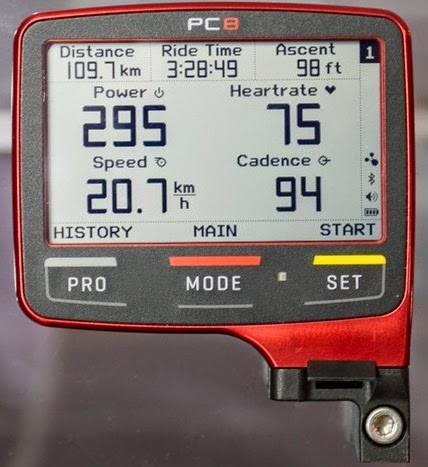 |
| Powercontrol 8 is due out soon. Pic: DC Rainmaker |
http://www.srm.de/home/
Update September 2014:
SRM have introduced some new models with user replaceable batteries, and others with battery life rated to 5 years. Also expected in the near future is an updated model of SRM's own handlebar computer, the Powercontrol 7, called somewhat amazingly, the Powercontrol 8.
Quarq
 | |
|
case with new power meter products) did suffer from some data quality issues, so it was good that Quarq's back up and service support has always had a top notch rating. Current models include the RIKEN, SRAM RED, RED22 and ELSA at different price points. They require just a little extra care in set up (e.g. proper torque spec of chainring bolts), and user calibration is possible with use of a smart phone or tablet and an additional communications dongle. No fixed gear option. Users outside of North America will need to check quality of their local support through SRAM distribution.
http://www.quarq.com/
Update September 2014:
Quarq have also introduced some new models including the new Shimano 4-bolt spider and the XX1 model for SRAM’s 1X drivetrains. Firmware upgrades have also seen improved temperature drift compensation, and cadence measurements in newer models no longer requires a cadence magnet, which matches the sans-magnet offerings from Power2Max and others, although you can still use a magnet if you wish (there are some advantages to this).
 |
| Powertap have really shaken up the market with a large price drop in August 2013. |
The second oldest of the well established power meter options, Powertaps have gone through several generations of development. As a hub/wheel based meter they are unique, and that in itself provide both flexibility (easy to swap a wheel across bikes) and a restriction (people do tend to have different training and racing wheels). Users can self validate calibration with no additional hardware/software, but a user cannot change a Powertap's calibration. The Powertap is probably the easiest of the established power meters to use, although none of them are overly difficult. As with Quarq, users outside of North America will need to check quality of their local support through local distributors. A significant price drop in August 2013 made Powertap an even more attractive option.
http://www.powertap.com/
Review - dcrainmaker
Review - BikeRadar
Review - pezcyclingnews
 |
| Power2Max have been quietly knocking out their keenly priced units for a couple of years now. |
The range of model options is impressive, and similar to SRM's range of options. In most cases the user will need to assemble the components and supply and fit chainrings and possibly also cranks arms (these are optional and can be supplied fitted). So make sure you know what you are getting or need to have a complete working unit. Distribution, sales and service support is newer of course and so depending on where you are located in the world, availability and means of sale may be not as consumer friendly yet as for the established players. Power2Max have worked hard to provide good after sales and service support for their customers but it would be a good idea to check the level of local support you can expect.
On 19 August 2013, Power2Max significantly updated their website with lots of new information and their sales and support options in some markets, in particular North America, which is a positive change, so that's good.
I don't have a good feel for their history or long term viability as a business, although the product and price point is relatively appealing and the August 2013 updates to website and sales processes are positive signs, but as always time will tell. In January 2014 I moved the Power2Max up into the established models category, as they have now passed three years and seem to have established a good foothold in the market.
http://www.power2max.de/
Review - dcrainmaker
Review - Rouleurville
Review - BikeRadar
 |
| The Garmin Vector promises to be a new power paradigm. Only time will tell. |
The pedal platform is Look compatible Exustar, and the pricing is similar to other mid- to high-range power meters. Initial reports testing the pedals shows a promising start on data quality front but it's early days still. The pedals do need to be installed correctly and tightened into the crank arms to a torque specification for them to report accurately. New power meter technology once released into the wild generally ends up with issues, so this is one for those that are not put off by the price point and have a stomach for early adopter status. I know you're out there. I've been there myself. Main issues for Vector users are to do with correct installation, and cracking the case of the transmission pods, which seem to be susceptible to damage. Much of this damage occurs when installing, and both Garmin and DC Rainmaker have put video tutorials out there to help users avoid such mistakes. Occasional pod damage has also been reported by people riding their bike over variable terrain/gutters etc.
Main advantage it provides is a very portable power meter and can perhaps help with some specialist applications (e.g. tandems). People find the thought of being able to swap pedals between bikes initially appealing - I'll be interested to see how that works out in practice though. Some are also excited by the prospect of being able to use them on their track bikes, although early indications suggest there may be impacts to or limitations with the data quality for track use (requirement to freewheel backpedal 8 times to set a zero and an upper cadence detection limit lower than what many track riders will often hit). I'm hoping to gather my data for this application from clients that are testing them.
I'll leave discussion of the left leg - right leg data for now, as that's not really an established performance improvement feature of any power meter. The pedals would appear to require a modest but not difficult level of installation care to ensure accuracy but we'll need to wait on real world results to assess its sensitivity to installation. DC Rainmaker did test their sensitivity to how tightly they are installed into the crank arms, and it confirmed they are sensitive to this, and so proper installation for accuracy requires use of a torque wrench, which also means you'll likely need a special adapter tool as most torque wrenches can't attach directly to the pedals.
In reality it's two power meters, one in each pedal, so that's double the things that can go wrong, and no doubt the data processing demand is higher. Transmission of data is a master/slave arrangement, with one pedal transmitting its data to the other, which then collates and transmits the data to the cycle-computer.
Durability is also yet to be proven, as pedals are one of the bike components that are most exposed to damage and wear and tear. The units are compartmentalised, meaning higher wear and damage prone parts can be replaced and the more expensive stuff is protected, but the real longevity and associated service costs will take years to establish. If you know you are hard on pedals, perhaps this is not the solution for you. And of course if you really want a pedal based power meter but don't want to use Exustar pedals, well for the time being you're out of luck until this technology is applied to other pedal manufacturers.
Garmin of course is a large company with significant financial resources and global representation, so one would expect them to be around for the long haul, as well as have a well established distribution and service/support network. Unless the product flops and gets dumped.
http://sites.garmin.com/vector/
Review - dcrainmaker
Review - BikeRadar
Update September 2014:
Garmin announced the introduction of the Vector S - which is a singled sided version of the Vector - measuring power at the left pedal only, but with an upgrade path to using Vector on both pedals.
https://buy.garmin.com/en-US/US/into-sports/cycling/vector-s/prod167943.html
 |
| Stages left leg power measurement looks to be an affordable option |
Stages is one of the lower cost options of the direct force / strain gauge power meters available, and on that front alone has quite an appeal for those unwilling or unable to spend more. It's compatible with ANT+ power enabled cycle-computers as well as bluetooth enabled devices. It would seem to be a pretty easy meter to use, and update of firmware not an overly difficult process.
Again it's still early days, and with permanent accuracy caveat due to Stages assumption that total power is double the single left leg measurement means some restriction on high end usability of data, but for general training progression and overall workload tracking, as well as real time guidance on level of effort, it is likely to be fine, subject to reliability/durability considerations yet to really be tested. You are however unlikely to be able to use data from a Stages to reliably perform higher end analysis work, such as refinements in aerodynamics, or peak force-velocity testing. The single leg measurement by its very nature makes it unsuitable for such applications.
Stages seems to have become a popular option with many new power meter users choosing them as their first power meter, while others are using them as an option for the second (or third) bike. There have been occasional reports of units which come away from the crank arm, and of water affecting operation. Stages it would appear have been quick to address any such issues with replacements.
The deal which sees Sky professional racing team using Stages power meters in 2014 will no doubt really give their brand a boost. There is chatter that Stages are looking at developing an option to also measure the right side crank, but details are thin.
Keep in mind that sales distribution and back up is still expanding so if you are hanging out for one, you might need to be patient, be prepared to risk not having local service, or consider other options that are available.
http://www.stagescycling.com/stagespower
Review - dcrainmaker
Review - Bicycling.com
These newer offerings show promise but need more time to prove themselves before moving into one of the other categories. I applied the same personal categorisation to Quarqs and Power2Max when they first arrived on the scene.
 |
| Rotor's power meter is still edging it's way to market. One to watch. |
This rather tasty looking offering from Rotor appeared in August 2012 and comes with an impressive specifications list, including ANT+ cycle-computer compatibility, however its availability is still very limited, with long wait lists or not at all in many markets and reports from early adopters of significant data quality and reliability problems. No doubt Rotor are refining as I type. Given the limited set of real world data, this one is definitely too new to categorise and hard to place in the recommended category.
http://power.rotorbike.com/
Review - dcrainmaker
Review - Bicycling.com
Review - NYVelocity.com
Review - BikeRadar
Update September 2014:
Rotor have announced a new option, the Rotor Power LT - a left sided only power meter - essentially half of their existing dual sided option. The LT is still priced higher than many other power meters, so it's hard to see how a left sided only option will win over well established total power measurement options from the likes of Quarq, Power2Max and Powertap.
http://www.rotorbike.com/products/road/power_198
http://www.rotorbike.com/products/road/power-lt_261
More details and commentary here at DC Rainmaker and Bike Radar:
http://www.dcrainmaker.com/2014/07/rotor-introduces-power.html
http://www.bikeradar.com/road/news/article/updated-rotor-power-lt-21-days-of-tour-tech-41631/
 |
| InfoCrank offers independent left and right side crank power measurement. |
Update September 2014:
Verve are now selling the Infocrank, limited options are available to purchase worldwide.
 |
| Polar Look Keo - may struggle against Garmin's Vector |
It is restricted to using Polar cycle-computer head units which have limited memory capacity, meaning an effective limit of approximately three hours of storage at a 1-second recording rate. That's a deal killer for a meter that's far more expensive than many others currently available. If the Garmin Vector works as one would hope, then I can't really see why anyone would go for the Polar given it's effectively the same pedal platform.
http://www.polar.com/en/products/accessories/keo_power
Review - dcrainmaker
Review - Bikeradar
MEP
 |
| MEP - lab grade power measurement |
MEP is an Italian company that popped up around 2010 with another crank based system, initially aimed at laboratories. It's not that well know or in regular use as far as I can tell, certainly not as a consumer power meter, and pricing is at the upper end at 3,500 Euro plus taxes. It seems to have its own PC based software, and links to software via a Bluetooth connection. It doesn't appear to be compatible with ANT+ cycle-computers but has its own smart phone application using a Bluetooth connection. They claim a very high level of accuracy at +/- 0.25%.
http://www.aip-mep.com/
 |
| Factor's crank based power meter is another new player in an increasingly growing list of options |
http://www.factorbikes.com/
Factor power measurement cranks (pdf)
Pioneer
 |
| New models now available. Gone are the zip ties. |
http://pioneer-cyclesports.com/us-en/products/sensor/index.html
http://www.pioneer.eu/eur/newsroom/news/CYCLING2012/page.html
http://www.dcrainmaker.com/2012/08/first-look-at-pioneer-ant-leftright.html
 Update September 2014:
Pioneer are now selling their power meters, with distributors and dealer in Europe, USA, Canada, Japan and Australia. They also have a new model to suit Shimano FC9000 and FC6800 cranksets and all meters are ANT+ compatible. Pricing still isn't clear from online sites.
Also available are two models of computer head units, the newest the wifi enabled CA500 to complement the CA900. Both are ANT+ compatible.

Brim Bros Zone
 |
| Brim Bros Zone - fits on your shoes. Well most shoes. Speedplay pedals only. |
http://www.brimbrothers.com/
Review - dcrainmaker
Update September 2014:
Brim seem to have made progress and are about to begin production and shipping to their pre-order list, although exact timing I'm not totally sure about. It would seem that late-2014 is a possibility. It's not yet available as an off-the-shelf product to purchase. The unit is designed for use only with Speedplay Zero pedal-cleat system, and for 3-hole cleat adapters only, not 4-hole cleat adapters.
Ray of DC Rainmaker got to sample the product and here is a link to his initial impressions:
http://www.dcrainmaker.com/2014/09/brothers-announces-production.html
It would seem there are still some data issues Brim need to work on, so time will tell if they come up trumps or not.
Watteam Powerbeat
 |
| Powerbeat attaches to your existing cranks |
It does require the user to glue the sensor to your crank arm and perform a calibration process. Specifics are not totally clear as yet, so time will inevitably tell if the data quality can match other current offerings.
http://watteam.com/
http://www.dcrainmaker.com/2014/08/eurobike-powerbeat-infocrank.html
4iiii
 |
| 4iiii's Precision is a pod you glue to your own crank arms. Single or double sided measurement. |
http://4iiii.com/
http://www.dcrainmaker.com/2014/09/4iiiis-introduces-precision.html
Xpedo
 |
| Xpedo offers a self-contained pedal based power meter. Pic: Cyclingnews |
http://www.xpedo.com/
DC Rainmaker provided an update during Interbike 2014, along with other model update information / reviews:
DCRainmaker
cyclingnews.com
Bike Rumour
Ashton Instruments
 |
| Ashton Instruments bottom bracket sensor provides a left sided only power measurement. Sort of an ergomo redux. |
http://www.ashtoninstruments.com/
http://www.bikeradar.com/au/road/news/article/ashton-instruments-previews-us500-power-meter-42416/
Luck
 |
| Luck's prototype power meter in a shoe. Pic: road.cc |
http://luck-bike.es/en/
http://road.cc/content/news/130089-luck-announces-shoes-built-power-meters
Power Pedals
http://www.bikepowerpedals.com/index.html
These models, based on the data and information as I currently understand it (and I could be wrong and am happy to be corrected) are currently not consistently meeting the data quality standards for many of the typical uses of a power meter, or they are hard to get, or are no longer in production or have service support.
However this does not mean they are not useful training aids, provided one understands their limitations and uses them wisely.
ibike
 |
| ibike present a novel way to estimate power and have a variety of models |
The ibike, which has several model variants, is a good training aid, but not for any application where a greater level of power data accuracy matters. It can however be used as a cycle-computer linked with existing ANT+ direct force power meter, and as such can then operate with a nice feature set compared with other units power meter head units.
http://ibikesports.com/cycling_power_meters.html
Review - dcrainamker
Review - cyclingnews.com
Powercal
 |
| Powercal is a heart rate monitor that estimates power |
http://www.powertap.com/collections/powercal
Review - dcrainmaker
Polar WIND
 |
| Polar's original power meter a novel design by Alan Cote |
ergomo
 |
| ergomo's status isn't clear and had a shaky track record |
 This left leg only power meter used optical sensors instead of regular strain gauges but required a tricky bottom bracket installation and accuracy was sensitive to how well the installation was done. It also faced the same issues as Stages power meter with the assumption that total power = double the left leg measured power.
ergomo used its own cycle-computer, which was actually quite innovative at the time. Generally only available second hand now but don't expect to find ready available service or support. ergomo went bankrupt and attempts have since been made to resurrect, although I'm not totally sure if the company is still breathing or not.
http://www.ergomo-systems.de/
Insufficient data/knowledge:
The following units I have little personal knowledge or experience with, so have decided not to categorise them.
 |
| G-Cog - dedicated BMX power meter |
http://www.ncbi.nlm.nih.gov/pubmed/23254482
https://twitter.com/Gcog
 |
| Axis Cranks measure both the radial and tangential forces on each crank arm |
A new Australian offering, which uses a load cell inside the custom designed crank arms to measures both radial and tangential forces on each crank, and so provides more detail than the total power from most power meters, enabling some analysis of these individual force components. The technology is designed for other applications as well, with cycling being the initial deployment. Currently it's sold only to research institutes and looks to be a customised crank set.
http://axiscranks.com/
Swedish Adrenaline
 |
| Swedish Adrenaline are working on another pedal based concept, but with vibrational frequency sensors to measure pedal forces. |
This Swedish (!) company announced in April 2013 they intended to develop a power meter, and in August 2013 commenced a crowd-funding project for a pedal spindle based power meter. There's limited information on progress that I can see (as at Feb 2014). The crowd funding project ended in October 2013 and raised less than 10% of the $50,000 sought. The technology appears conceptually interesting, with vibrational frequency strain gauges located inside pedal spindles, using a principle analogous to the way Alan Cote's original Polar chain based meter worked. I have not seen any public demonstration of their product.
http://www.swedishadrenaline.com/
Indiegogo crowd funding page
Swedish Adrenaline Facebook page
This German powermeter is not that well documented or known and the primary information source is in German. It woud appear to provide measurement or some means to apportion the forces at various leg joints. It's not clear what the uses are beyond laboratory settings.
http://www.caloped.de/
Velocomputer
 |
| Velocomputer - an unknown option |
http://velocomputer.com/views/index.jsp
Laser spoke
This is a Northern Ireland based crowd funded project to develop a power meter, using a laser device to measure the distortion of the rear wheel rim and derive power from that and wheel speed. It appears they have not secured much funding for the next stage of development, and there has been no reported activity for since early 2012, so this one is firmly in the vapourware column for now.
http://www.laser-spoke.com/
http://www.indiegogo.com/projects/laser-spoke-power-meter-for-cyclists